

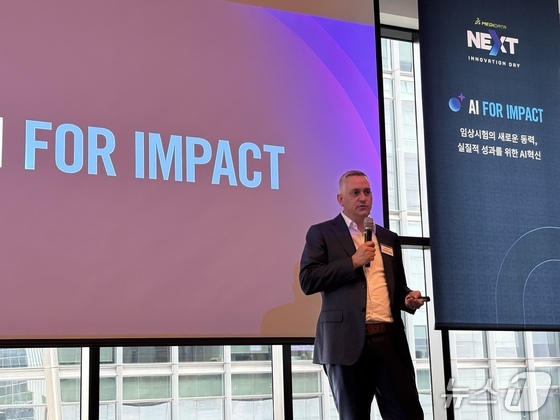
“AI is no longer an experimental technology but core infrastructure that is generating tangible results across the clinical trial lifecycle.”
Jeff Ventimiglia, senior vice president at Medidata, made the remarks during a media briefing held June 17 at Conrad Seoul in Yeongdeungpo District, Seoul. “AI can transform fragmented data into actionable insights, improving the speed, quality and predictability of clinical trials,” he said.
Medidata, the life sciences brand of Dassault Systèmes, hosted NEXT Innovation Day Seoul on the same day, sharing its strategy for transforming clinical trials through artificial intelligence and presenting real-world applications.
The event, held under the theme “AI for Impact: AI Strategies for Practical Outcomes in Clinical Innovation,” drew representatives from domestic pharmaceutical and biotechnology companies, contract research organizations (CROs), and academia.
During keynote presentations, Ventimiglia and Vice President Ken Hamill emphasized that AI has evolved beyond a simple data-analysis tool and is becoming core infrastructure that is reshaping the entire clinical trial ecosystem.
They explained that integrating patients, studies and data into a single platform can reduce the burden on trial participants while improving research operations. They added that data integration and real-time analytics can shorten clinical trial timelines and increase the likelihood of success.
Medidata also highlighted Dot, its AI orchestrator built on data from more than 38,000 clinical trials and more than 12 million patients.
Dot is a platform designed to connect patient, study and data experiences, integrating workflows across the entire clinical trial process. By linking previously fragmented tasks and datasets, the platform aims to improve operational efficiency.
The company also unveiled Medidata Plus, a next-generation AI-powered platform. The subscription-based service supports the entire clinical trial lifecycle, from planning and execution to analysis and closeout.
Medidata Plus provides a unified ecosystem that spans every stage of clinical development without interruption. The company said the platform, combined with Dot, is expected to maximize operational efficiency and accelerate innovation in the life sciences sector.
In addition, Hanmi Pharmaceutical presented a case study on the use of electronic clinical outcome assessments (eCOA) in a chronic low back pain clinical trial, while Seoul National University Hospital introduced hyper-customization AI strategies for clinical research.
Meanwhile, Medidata has hosted global events for life sciences professionals since 2006 in the United States, Europe, South Korea, China and Japan, sharing the latest trends and insights in clinical research.