

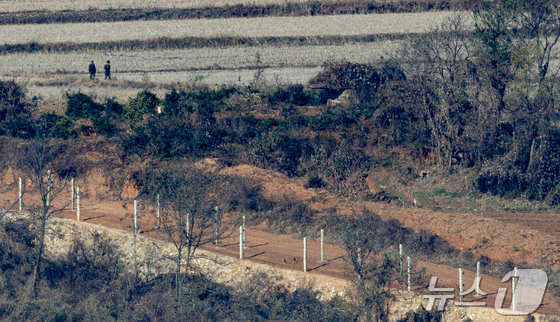
On Tuesday, a former United Nations Command (UNC) official stated that North Korea’s military activities near the Military Demarcation Line (MDL), known as the border fortification project, do not violate the armistice agreement. This project, aimed at severing ties between North and South Korea, has been ongoing for about two years. The official noted that South Korean forces have conducted similar operations, and there’s no clear evidence suggesting that the installation of obstacles like landmines and barbed wire indicates an intent to attack South Korea.
Michael Bosack, who served as the deputy secretary of the UNC Military Armistice Commission from August 2019 to November 2022, shared his perspective on social media. He stated that from a practical standpoint based on the armistice agreement, actions such as barbed wire installation and landmine placement are considered construction and maintenance activities. Bosack added that the South Korean military also conducts similar operations in the southern region, including landmine placement, fence installation, and barrier construction.
Previously, the UNC acknowledged North Korean forces’ unprecedented border fortification activities, such as installing barbed wire within 100 meters north of the MDL. The UNC maintained that these actions don’t necessarily violate the armistice agreement, stating that construction activities, fortification, defensive actions, or the mere presence of personnel do not automatically constitute a violation. However, the South Korean Ministry of National Defense recently expressed a conflicting view, asserting that North Korea’s activities near the MDL do violate the agreement.
Some analysts interpret Bosack’s comments as a detailed explanation of the current UNC position.
Bosack emphasized that the key criterion for determining an armistice violation is the military balance within the DMZ. He noted that if North Korea introduces equipment and forces that disrupt this balance, the situation would change. However, they are not currently doing so. Bosack stressed that any unauthorized intrusion across the MDL would constitute a clear violation of the armistice agreement.
The former UNC official argued that there’s no evidence suggesting North Korea’s fortification activities are hostile. In fact, he contended that these actions practically create a military buffer zone.
Bosack explained that all evidence regarding North Korea’s activities near the MDL indicates they are strengthening the border to prevent unauthorized crossings. He added that they aren’t laying landmines in front of potential invasion routes, which suggests this isn’t preparation for an offensive.
From a practical standpoint, Bosack continued that the North Korean military is effectively delineating the border by adding a buffer zone north of the MDL as designated by the armistice agreement. This actually reduces the risk of unauthorized crossings in the long term.
However, Bosack acknowledged that North Korea’s fortification efforts could become a contentious issue in South Korean domestic politics. He observed that while these actions support practical stability on the ground, they cause friction at higher political levels. Bosack explained that this friction stems from two factors: the visual representation of a hostile two-state paradigm that South Korea doesn’t accept, and the South Korean government’s claim that its stance doesn’t align with that of the U.S.-led UNC, potentially raising alliance management issues.