

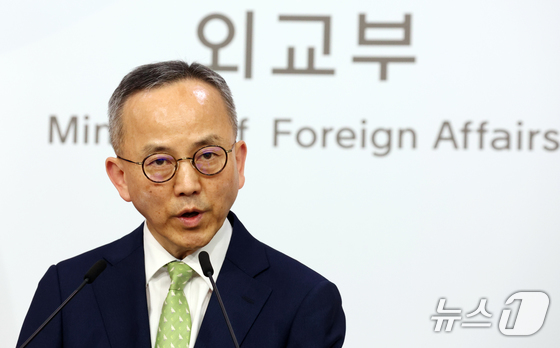
The government has rebutted North Korean leader Kim Jong Un’s criticism of South Korea-U.S. discussions on nuclear-powered submarines, stating that the development is necessary to counter North Korea’s advancing nuclear and missile capabilities and the rapidly evolving security landscape on the Korean Peninsula.
On Tuesday, a State Department official told reporters that the extended deterrence cooperation between South Korea and the U.S. is the duty as a responsible government to protect the citizens’ lives and safety. This fully complies with international non-proliferation regimes and norms, including the Nuclear Non-Proliferation Treaty (NPT).
The official emphasized that the denuclearization of the Korean Peninsula remains a consistent goal affirmed by numerous United Nations (UN) Security Council resolutions. The government will steadfastly pursue efforts to achieve a war-free and nuclear-free peninsula under the vision of peaceful coexistence and mutual growth.
According to the Rodong Sinmun, Kim strongly condemned South Korea’s pursuit of nuclear submarines during the second plenary meeting of the 9th Central Committee of the Workers’ Party from June 20-22. He stated that even this year, the U.S. and South Korea have been blatantly escalating regional military buildup and modernization efforts, including South Korea’s push for nuclear submarines, while constantly conducting military exercises and surveillance activities targeting the nation, severely deteriorating the situation on the Korean Peninsula.
The State Department also addressed China’s recent criticism of the South Korea-U.S. extended deterrence cooperation. Spokesperson Park Il stated during a regular press briefing that maintaining a robust deterrence posture through South Korea-U.S. cooperation is a legitimate response to protect the citizens and a fundamental duty of a responsible government, especially given North Korea’s advancing illegal nuclear and missile programs.
Park further explained that the cooperation between South Korea and the U.S. fully aligns with the NPT’s goals and obligations. South Korea continues to faithfully fulfill its NPT commitments and reaffirm its dedication to the international non-proliferation regime.
The spokesperson added that it hopes China, as a responsible nation, will play a more prudent and constructive role based on a deep understanding of international norms and regional dynamics to achieve the shared goals of denuclearization on the Korean Peninsula and regional peace and stability.
Earlier, Chinese Foreign Ministry spokesperson Lin Jian expressed serious concerns during a June 18 briefing about the recent South Korea-U.S. Nuclear Consultative Group (NCG) meeting and the U.S.-Japan Extended Deterrence Dialogue (EDD). While harshly criticizing Japan, Lin expressed regret towards South Korea, urging it to act cautiously and contribute more to regional stability.
However, sources indicate that our government does not view the recent criticisms from China and North Korea as a coordinated effort against South Korea-U.S. cooperation. While China and North Korea appear to be aligning in response to the South Korea-U.S.-Japan cooperation framework, the government reportedly assesses that there are divergent views between North Korea and China on denuclearization issues.