

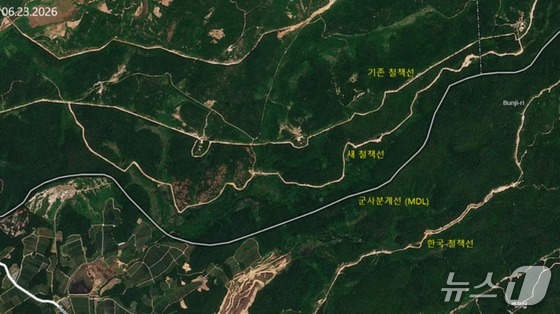
Satellite imagery has revealed North Korea’s recent expansion of facilities near the Military Demarcation Line (MDL), including the installation of new security fencing, according to a Wednesday report by Voice of America (VOA).
VOA’s analysis of Planet Labs satellite imagery from Tuesday shows newly constructed fencing in the Bunjiri and Eoryongri areas of Paju, Gyeonggi Province, just north of the MDL.
A notable addition is a dirt path running alongside the new fence, situated between the MDL and North Korea’s existing barrier. This path, absent from satellite images taken in May 2024, is believed to be part of Pyongyang’s ongoing border fortification efforts.
The new fencing has been positioned significantly closer to the MDL than its predecessor.
VOA’s analysis indicates that at its nearest point, the new fence is approximately 82 meters (about 0.05 miles) from the MDL, with other sections ranging from 108 to 196 meters (about 0.067 to 0.12 miles), mostly within 200 meters (about 0.12 miles) of the line.
Previously, North Korea’s fencing was set back several hundred meters from the MDL, typically maintaining a distance of 600 to 700 meters (about 0.37 to 0.43 miles) or more, VOA reported.
These findings corroborate recent South Korean media reports detailing North Korea’s activities north of the MDL since last year. Under Kim Jong Un’s directives, these efforts reportedly include creating barren zones, building tactical roads, installing wire obstacles, and laying mines, with some barriers now as close as 80 to 90 meters (about 0.05 to 0.056 miles) from the MDL.
South Korea’s Ministry of National Defense has previously condemned these actions, stating that North Korea’s installation of obstacles near the MDL violates the spirit of the armistice agreement, which designates the Demilitarized Zone (DMZ) as a buffer area.
In response to VOA’s inquiry, the United Nations Command, responsible for overseeing the armistice, stated that activities within the DMZ must be evaluated in their full context, considering specific circumstances and relevant provisions of the armistice and subsequent agreements. They noted that construction, fortification, and other defensive measures do not inherently constitute violations of the armistice.
Since last year, North Korea has intensified large-scale fortification projects along its frontlines, particularly after redefining inter-Korean relations as a hostile relationship between two states. This shift has accelerated efforts to enhance border control facilities and strengthen military vigilance in frontier regions.