

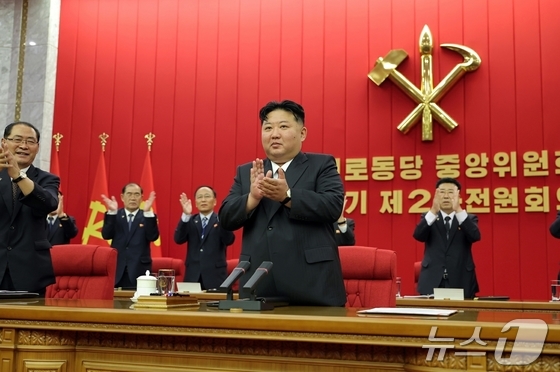
North Korean leader Kim Jong Un has reaffirmed his intention to continue hostile policies towards South Korea and the U.S., while justifying the strengthening of nuclear forces, through a plenary meeting that discusses and decides on major policies for the first half of the year.
As expectations grew for the resumption of U.S.-North Korea dialogue in the latter half of this year, amid the recent atmosphere of reconciliation between the U.S. and Iran and the possibility of President Donald Trump turning his attention to North Korea, interpretations on Wednesday leaned towards this announcement pouring cold water on such hopes.
However, some experts suggest that it’s necessary to observe whether North Korea’s hardline stance means they won’t allow even the slightest contact with the U.S. and South Korea, or if it’s a strategic move considering potential negotiations with the U.S. They argue it could be a gesture to increase bargaining power.
During the 2nd Plenary Meeting of the 9th Central Committee of the Workers’ Party held from June 20-22, Kim stated that it must firmly maintain the party’s principle of struggle against the enemy, which has officially recognized South Korea as the most hostile state. He had previously defined South Korea as the most hostile state in his policy speech to the Supreme People’s Assembly last March, and has now reaffirmed this position at the plenary meeting.
Furthermore, Kim criticized the cooperation between South Korea and the U.S. for the introduction of nuclear-powered submarines, while justifying their own nuclear development policy as a response to external threats. He emphasized that continuously expanding and strengthening nuclear forces and thoroughly exercising the status of a nuclear state is the most accurate and only way to confidently deal with the unpredictable international military-political situation, urging to continue implementing projects to increase powerful national defense assets without pause and with great force.
He also ordered the thorough completion of the fortification work to isolate the southern border adjacent to South Korea, and commanded the construction of a new weapons system called a 10,000-ton strategic guided missile cruiser.
Despite recent dialogue gestures from the leaders of South Korea and the U.S. towards North Korea, Pyongyang still maintains its stance on hostile policy towards South Korea and strengthening nuclear forces, making it unlikely for the situation to change immediately. Particularly, as the Workers’ Party plenary meeting held at the end of June is a venue to evaluate policy achievements for the first half of the year and discuss directions for the second half, this stance is expected to continue at least until the end of this year.
Hard-Line Stance Emerges After Korea-U.S. Leaders’ Overture for Dialogue; Could Be Strategic Indifferece’
On June 13, President Trump posted a photo of himself walking alongside Kim on his social media platform, Truth Social. The image was from June 12, 2018, just after the first U.S.-North Korea summit, showing the two leaders strolling in the garden of the Capella Hotel on Singapore’s Sentosa Island.
While no explanation was provided, interpretations emerged that Trump might be hinting at North Korea as his next negotiation partner, especially as he was about to sign a ceasefire memorandum of understanding (MOU) with Iran. Some analysts suggest that Trump might pursue a large-scale event like a U.S.-North Korea summit to sway public opinion and secure victory in the upcoming U.S. midterm elections in November.
For the South Korean government, which has been expressing hope for the resumption of U.S.-North Korea dialogue amid unprecedentedly frozen inter-Korean relations, Trump’s silent message was indeed a factor that raised expectations for renewed talks with North Korea.
Minister of Unification Chung Dong-young lent weight to the interpretation on Monday that there’s a possibility that a quiet letter from Secretary Kim arrived on the occasion of President Trump’s birthday regarding the background of President Trump’s social media post. This suggests that President Trump might have received a letter from Secretary Kim and posted in response to it. Minister Chung added that in any case, it hopes that U.S.-North Korea contact and dialogue will be reactivated.
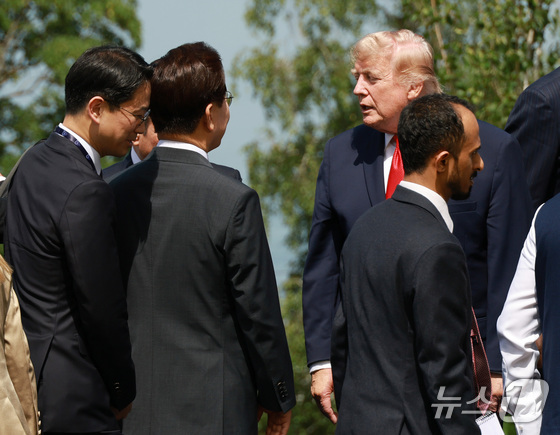
President Lee Jae Myung also recently discussed the North Korean nuclear issue with President Trump during the Group of Seven (G7) summit. In a press briefing on June 19, Lee conveyed that Trump expressed interest in North Korea, stating that it’s time to pay attention to the North Korean issue.
President Lee also mentioned a step-by-step solution to the North Korean nuclear issue, introducing that he responded to Trump by saying that the U.S. is the only party that can engage in dialogue with North Korea. It hopes (President Trump) can propose a realistic plan that North Korea can empathize with.
The fact that President Lee publicly shared his conversation with President Trump immediately after returning home was interpreted as an indirect attempt to show the willingness of both South Korean and U.S. leaders to meet and negotiate with North Korea.
However, Kim did not respond to this and instead raised the level of criticism against South Korea and the U.S. through this plenary meeting. By mentioning that cooperation between South Korea and the U.S. poses a significant threat to the security of the Korean Peninsula and that there is a need to ally with anti-U.S. friendly nations, he implied that North Korea is unlikely to deviate from its strength-for-strength stance voluntarily outside its camp.
Professor Lim Eul-chul of Kyungnam University’s Far East Institute pointed out that through this plenary meeting, Kim has expressed his intention to intensify confrontation with the West, including the U.S., rather than easing tensions on the Korean Peninsula or creating an atmosphere for dialogue, and to confront head-on those who do not recognize their status as a nuclear state.
However, there are interpretations that Kim and North Korean authorities’ frequent emphasis on their nuclear state status and active messaging towards the U.S. this year may have its own strategic intentions. It could be strategic indifference aimed at securing a more advantageous position in case of future U.S.-North Korea nuclear negotiations.
In fact, during the 9th Party Congress in February, Kim stated that there would be no reason not to engage in dialogue if the U.S. withdraws its hostile policy towards them and recognizes their position as a nuclear state.
Professor Yang Moo-jin of the University of North Korean Studies saidNorth K that orea has made it clear that denuclearization is absolutely impossible if U.S.-North Korea negotiations resume, adding that the message from this plenary meeting also appears to be intended to shift the frame of the U.S.-North Korea summit to nuclear arms reduction negotiations.