

Researchers have developed an innovative learning technology that enables swarms of autonomous drones to maintain their mission objectives even when their coordinated teamwork is disrupted.
On Wednesday, a team led by Professor Han Seung-yeol from the Graduate School of Artificial Intelligence at the Ulsan National Institute of Science and Technology (UNIST) unveiled a groundbreaking technique called Interaction-Breaking Adversarial Learning (IBAL). This method trains AI agents by deliberately disrupting their cooperative links.
The newly developed IBAL empowers remaining AI units to discover novel collaboration strategies and persist with their assigned tasks, even when some units malfunction or fail to accurately assess their teammates’ positions and status.
To enhance this adaptive capability, the training regimen repeatedly simulates scenarios where the cooperative network breaks down.
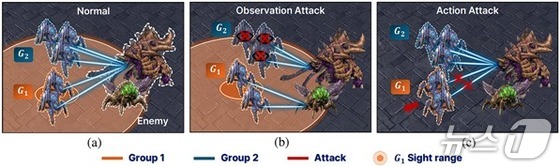
The research team divided the artificial intelligence (AI) agents into two groups, analyzed the critical information and actions necessary for cooperation, and then obscured key data to provoke behaviors that would disrupt collaboration.
Furthermore, they randomized group configurations at each learning stage and dynamically adjusted the intensity of simulated attacks based on the training context. This approach allowed the AI to experience a wide spectrum of cooperation breakdown scenarios.
To validate their findings, the team used the popular strategy game StarCraft II and its experimental environment (SMAC) to simulate sudden failures in a subset of allied units.
The results were striking: conventional AI models suffered a domino effect, with their entire cooperative system collapsing when team members were lost. Some models saw their win rates plummet to a mere 13.3%.
In contrast, AI systems trained with IBAL demonstrated remarkable adaptability. They successfully restructured their formation by withdrawing weakened units to the rear and positioning healthy ones at the forefront, achieving an impressive 87.0% win rate.
This groundbreaking technology is poised to revolutionize systems where multiple AI units operate in tandem, such as autonomous drone swarms, robot collectives, and smart factories.
Professor Han expressed optimism about the technology’s potential, stating that this innovation will enable remaining AI units to autonomously reassign roles and maintain mission objectives even in unexpected situations. It lays the foundation for significantly enhancing the safety and reliability of multi-AI collaborative systems.
The team’s research findings have been accepted for presentation at the International Conference on Machine Learning (ICML) 2026, one of the world’s top three artificial intelligence conferences. ICML 2026 is scheduled to take place from July 6 to 11 at COEX in Seoul.