

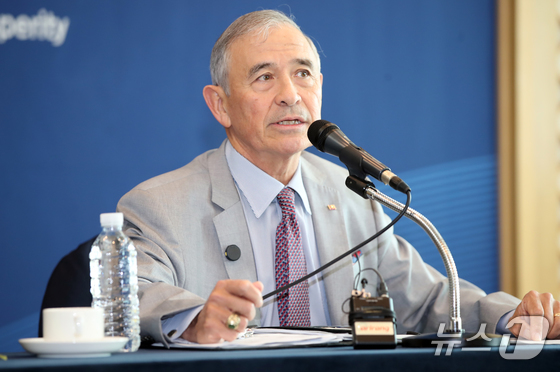
Former U.S. Ambassador to South Korea Harry Harris stated on Thursday that allied nations who have recently rejected U.S. requests for assistance may say no to American proposals based on their national interests. However, he added that the U.S. could subsequently take actions based on its own interests in response. Harris served as the U.S. Ambassador to South Korea during Donald Trump’s first term.
Speaking at the 21st Jeju Forum held at the Haevichi Hotel in Seogwipo, Jeju, Harris addressed concerns about the recent lack of cooperation between the U.S. and its allies, particularly in light of ongoing conflicts in the Middle East. He emphasized that whether U.S. actions are viewed positively or negatively, they are decisions and judgments based on individual national interests.
Harris commended South Korea’s 350 billion USD investment plan in the U.S., describing it as an exemplary model of alliance. He characterized these investment projects as mutually beneficial, highlighting how they demonstrate the trust and shared values underpinning the U.S.-South Korea alliance.
Drawing on the examples of North Korea and Iran, he underscored the importance of robust alliances, partnerships, and sustained defense investments.
Regarding the North Korean nuclear issue, Harris expressed disappointment, noting that North Korea’s nuclear capabilities have advanced while the U.S. relied solely on diplomacy across six administrations.
He added that President Trump has recently shifted his focus to the North Korean issue. Trump is encouraging Iran to abandon its nuclear ambitions through a novel approach, suggesting he might adopt a similar strategy for the North Korean nuclear problem.
The session, titled, Collective Defense or Collective Security, explored the erosion of existing collective security systems due to recent Middle East conflicts and escalating U.S.-China tensions in the Indo-Pacific region. Alongside Harris, the panel included former South Korean Defense Minister Suh Wook, former Australian Defense Minister Robert Hill, and former Japanese National Security Bureau Chief Shigeru Kitamura, representing various countries’ diplomatic and security sectors.
Suh emphasized that the key challenge in East Asia is not merely expanding alliances but maintaining strong deterrence while ensuring strategic stability. He argued that it must strengthen existing frameworks like the U.S.-South Korea and U.S.-Japan alliances while preventing this from devolving into bloc competition or a new Cold War. Simultaneously, it should maintain strategic communication with rival states through established channels.