

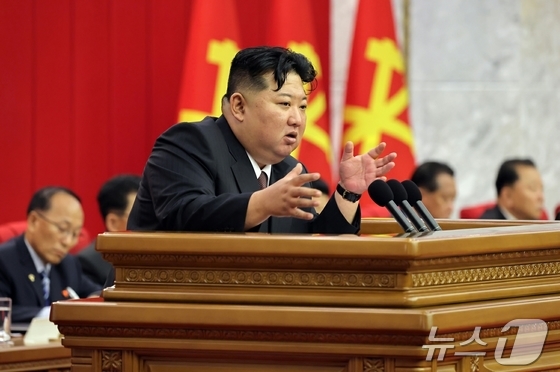
North Korea held an expanded plenary meeting of the 9th Central Committee of the Workers’ Party of Korea from June 20 to 22. The meeting assessed the implementation of party and state policies for the first half of the year and discussed important issues for the second half. The plenary meeting is a body that deliberates and decides on major internal and external party issues when a party congress is not in session.
The agenda for this party plenary meeting included four items: evaluating the progress of work in the first half of the year, adopting resolutions on Revitalizing the Coal Industry and Transforming Coal Mining Villages Nationwide and Measures to Enhance the Role of City and County People’s Committees, and organizational matters.
Kim Jong Un, General Secretary of the Workers’ Party, outlined the party and state policy directions, short-term and mid-to-long-term tasks for the future, and made important conclusions regarding the first agenda item. North Korean media focused on disclosing only the aspects related to strengthening national defense capabilities among these important conclusions.
First, Kim reaffirmed the policy of strengthening self-defensive deterrence centered on nuclear forces. He stated that power is national authority and dignity, and declared that they would more offensively pursue efforts to expand and strengthen self-defensive deterrence. In this regard, he emphasized the expansion and strengthening of nuclear forces and naval power, and also ordered the expansion of the defense industry base.
Kim used the alleged nuclear threat from South Korea and the U.S. as justification for strengthening nuclear forces. He specifically targeted the Nuclear Consultative Group (NCG), an extended deterrence enhancement consultative body established through the Washington Declaration resulting from the 2023 Republic of Korea (ROK)-U.S. summit. The ROK and U.S. held the 6th NCG meeting in Seoul on the 11th and issued a joint statement confirming their shared goal of North Korea’s denuclearization. Kim defined the NCG as a nuclear war organization to attack North Korea, claiming that detailed nuclear war scenarios have been drawn up in the six simulations (meetings) held so far, covering war methods, mission procedures, training, and operational elements.
In response, he emphasized that continuously expanding and strengthening nuclear forces, which are the core of North Korea’s military sovereignty and the backbone of war deterrence and implementation strategy, and thoroughly exercising their status as a nuclear state, is the most accurate and only way to proactively and confidently deal with the unpredictable and complexly changing international military-political situation.
Kim also reaffirmed the principles of anti-South struggle. He stated that they must strictly adhere to the anti-enemy struggle principles of the party, which has officially recognized South Korea as the most hostile state, and ordered the qualitative completion of the ongoing southern border fortification project. This confirms that the visit of the Hometown Soccer Team to South Korea and Jeju Island’s humanitarian aid are unrelated to the anti-enemy struggle principles.
The adoption of resolutions related to the remaining two agenda items is a measure to expand and support North Korea’s recent focus on local development policies. In particular, it was decided to begin modernizing housing in coal mining villages nationwide starting next year. In his policy speech at the 1st Session of the 15th Supreme People’s Assembly on March 23, Kim had ordered a complete renovation of mining districts by conducting large-scale construction projects for four years, building about 20,000 households annually with national resources during the five-year plan period. It appears that specific implementation plans were finalized at this plenary meeting.
North Korea is pursuing a 20×10 Local Development Policy to build modern local factories in 20 counties within 10 years starting from 2024. Initially, only local factory construction was announced, but it has since expanded to include rural housing, medical and educational facilities, grain storage facilities, and comprehensive service centers. Now, the modernization of coal mining villages has been added to this list. Contrary to external assessments that North Korea’s local development policy is likely to face limitations due to the need for massive financial and material resources, North Korea is actually expanding the scope of its projects. North Korea is particularly promoting that local development projects are not just economic endeavors but also political projects to nurture local youth, emphasizing the need to focus on reducing the gap between urban and rural areas.
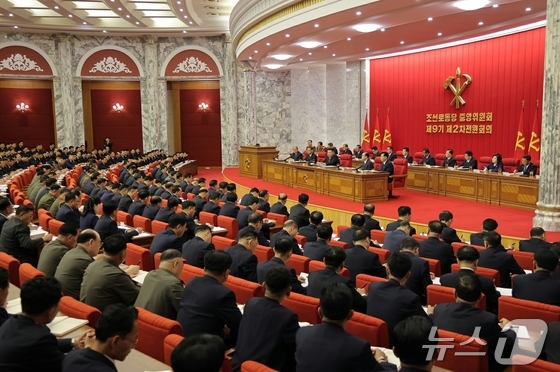
The policy lines and directions confirmed at this plenary meeting are in line with those presented at the 9th Party Congress held in February this year and Kim’s policy speech at the Supreme People’s Assembly in March. It’s noteworthy that the emphasis on expanding nuclear forces and the principles of anti-South struggle can also be seen as North Korea’s response to the recent “dialogue gestures” by the South Korean and U.S. leaders.
On June 13, President Trump posted a photo of himself walking with Kim Jong Un from the 2018 Singapore summit on his social media account. This immediately led to speculation that Trump might be hinting at North Korea as the “next negotiation partner” as he approached signing a ceasefire MOU with Iran. Minister of Unification Jeong Dong-young also lent credence to the interpretation that a personal letter from Kim Jong Un might have quietly arrived on Trump’s birthday. The theory suggests that Trump may have received the letter and posted the photo in response.
President Lee Jae-myung also revealed that he discussed the North Korean nuclear issue with President Donald Trump during the recent G7 summit. In a press briefing on June 19, Lee reported that Trump initiated the conversation, saying it was time to pay attention to the North Korean issue, showing interest in U.S.-North Korea dialogue. Lee’s public disclosure of his conversation with Trump immediately after returning home is interpreted as an indirect attempt to convey that both South Korean and U.S. leaders are willing to meet and negotiate with North Korea.
It seems highly likely that the U.S. and Japan have conveyed their willingness for dialogue to North Korea through “indirect channels.” However, Kim Jong Un did not respond directly, instead using this plenary meeting to escalate criticism of South Korea and the U.S. This clearly indicates that North Korea is not interested in “dialogue without preconditions” that lacks pressure for denuclearization and the abandonment of hostile policies.
During the North Korea-China summit held in Pyongyang on June 8, North Korea also criticized the U.S. extended deterrence and expressed wariness about strengthening security cooperation between South Korea and Japan, and among South Korea, the U.S., and Japan. This overtly demonstrates their will to confront head-on those who do not recognize their status as a nuclear state. At the 9th Party Congress, Kim stated that there would be no reason not to engage in dialogue if the U.S. withdraws its hostile policy and recognizes North Korea’s position as a nuclear state. However, he has set “abandonment of hostile policies and recognition as a nuclear state” as preconditions for dialogue – conditions that the U.S. and South Korea are unlikely to accept immediately.
President Lee mentioned a “step-by-step solution” to the North Korean nuclear issue to President Trump, suggesting that the U.S. is the only party that can engage in dialogue with North Korea. He proposed that Trump should present a realistic plan that North Korea could agree with. This introduces the government’s approach to North Korea, which aims to initiate U.S.-North Korea dialogue using the “suspension” of North Korea’s nuclear activities as a starting point, with the ultimate goal of achieving denuclearization of the Korean Peninsula. However, through this plenary meeting, North Korea reaffirmed the expansion and strengthening of its nuclear forces rather than suspending nuclear activities. Earlier, North Korea had also unveiled a newly operational nuclear material production plant (highly enriched uranium manufacturing facility).
With North Korea reaffirming its nuclear force strengthening policy and China publicly shifting its policy to not mention the North Korean nuclear issue, the government’s “step-by-step solution” is objectively unlikely to yield results in the short term. In a situation where North Korea defines South Korea as a hostile state, it is not easy to garner public consensus for constitutional amendments accepting North Korea’s two-state theory or discussions on inter-Korean cooperation projects.
In this regard, rather than fixating on a “breakthrough in inter-Korean dialogue,” the government should focus on coordinating differences between ministries and securing public consensus to “institutionalize peaceful coexistence on the Korean Peninsula,” which is set as an immediate goal in the “Korean Peninsula Peaceful Coexistence Policy.” The positions of the Ministry of National Defense, which plans to maintain expressions defining the North Korean regime and military as enemies in the new defense white paper to be published this year; the Ministry of Unification, which argues that peaceful coexistence cannot be pursued while defining North Korea as the main enemy; and the Ministry of Foreign Affairs, which views ROK-U.S. and U.S.-Japan extended deterrence cooperation as a justified response to North Korea’s advancing nuclear and missile programs, raise doubts about whether the government maintains unity and consistency regarding the “Korean Peninsula Peaceful Coexistence Policy.” Securing internal societal consensus and institutionalizing the “Korean Peninsula Peaceful Coexistence Policy” is necessary to maintain long-term policy stability and create space for inter-Korean cooperation.