

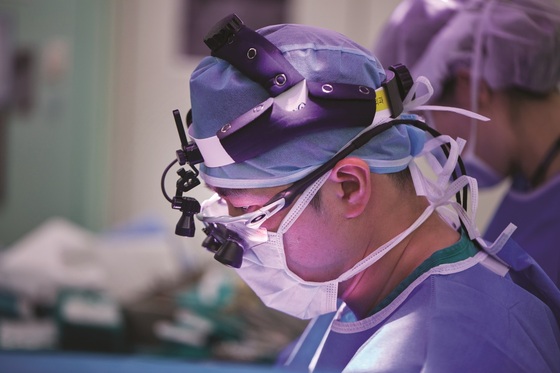
Severance Hospital has achieved a groundbreaking medical milestone by successfully performing robotic Kasai surgery on the world’s youngest and lightest newborn patient.
The hospital announced on Wednesday that it had conducted the Kasai procedure on a 14-day-old infant weighing just 3.14 kg (about 6.92 lbs), directly connecting the liver to the small intestine.
Biliary atresia, a rare and challenging condition affecting approximately 1 in 10,000 newborns, prevents bile from flowing into the small intestine to aid in fat digestion, causing it to accumulate in the liver instead.
In this pioneering case, Severance Hospital performed the Kasai surgery to create a direct connection between the liver and small intestine, bypassing the obstructed bile duct.
This groundbreaking robotic Kasai surgery on a child with biliary atresia weighing less than 4 kg (about 8.82 lbs) marks the first documented case worldwide for the youngest and lightest patient to undergo this procedure.
Dr. In Kyung, a renowned pediatric surgeon, performed the intricate robotic Kasai surgery on Baby A, who was born with biliary atresia. The operation lasted 5 hours and 8 minutes on June 4. The procedure was remarkably smooth, with minimal bleeding, eliminating the need for a blood transfusion. Following the surgery, Baby A demonstrated an excellent recovery without complications and was discharged on Tuesday, returning home with her family.
During her pregnancy, Baby A’s mother learned through prenatal ultrasound that the fetus had a cystic lesion in the lower part of the liver. The presence of fluid-filled cystic lesions can indicate potential abnormalities in the bile duct, necessitating further examination.
Seeking expert care, Baby A’s mother promptly consulted Dr. Kwon Ja-young at Severance Hospital’s High-Risk Maternal-Fetal Integrated Care Center. A multidisciplinary team, including neonatologist Dr. Eun Ho-sun and pediatric surgical staff, collaborated from the prenatal stage to develop a comprehensive treatment plan ensuring Baby A would safely undergo surgery after delivery.
Immediately after birth, Baby A was transferred to the neonatal intensive care unit for thorough examinations. On her second day of life, an abdominal ultrasound confirmed the presence of a cystic lesion in the lower liver, leading the medical team to suspect biliary atresia and opt for early surgical intervention.
Biliary atresia, if left untreated, can lead to rapid accumulation of bile, causing liver damage that may progress to cirrhosis or liver failure. The standard treatment for this condition is the Kasai procedure, which involves removing the blocked bile duct and creating a direct connection between the liver (hepatic hilum) and the small intestine to restore bile flow. While the Kasai procedure is not a cure for biliary atresia, it aims to restore bile drainage, slow the progression of liver damage, and delay the need for a liver transplant. The procedure is named after the Japanese doctor who pioneered it.
The robotic Kasai surgery performed at Severance Hospital demanded exceptional skill due to the infant’s small size and the need to manipulate organs within a confined abdominal cavity. To meet this challenge, the hospital assembled a multidisciplinary team, including experts from pediatric surgery, neonatology, obstetrics, anesthesiology, surgical nursing, and the robotic endoscopic surgery center.
Dr. In emphasized the critical importance of timely intervention, stating that delaying treatment can lead to accelerated liver damage in cases of biliary atresia. Early diagnosis and prompt surgical intervention are crucial. He added that performing robotic Kasai surgery on a newborn weighing around 3 kg (about 6.61 lbs) presents significant challenges in terms of surgical space and instrument manipulation. However, the precision offered by robotic surgery, combined with the seamless multidisciplinary collaboration at Severance Hospital, enabled them to complete the procedure successfully.