

North Korea’s recent upgrades to a significant portion of its tactical and strategic missiles have increased the burden on U.S. and South Korean intelligence agencies to conduct thorough analyses. The time required to gather and analyze related information has substantially increased. On Wednesday, criticism emerged regarding the agencies’ inability to accurately assess North Korea’s recent ballistic missile launches.
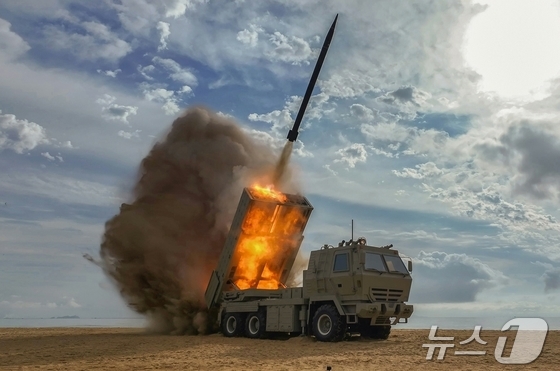
Reports indicate that during North Korea’s provocations on June 25, when it launched multiple rockets, self-propelled artillery, and suspected short-range ballistic missiles using a mixed firing strategy, U.S. and South Korean intelligence failed to immediately determine if ballistic missiles had been launched. North Korea claimed to have equipped its ballistic missiles with special mission warheads, suggesting it adjusted the missiles’ range for the launch.
Typically, North Korea tests short-range ballistic missiles (SRBMs) with ranges adjusted to approximately 300 to 600 km (about 186 to 373 miles). However, it’s possible that the range of the recent ballistic missiles fell significantly short of this. Given that U.S. and South Korean forces have been able to identify close-range ballistic missiles (CRBMs) or the super-large multiple rocket launchers, which are effectively ballistic missiles, it’s plausible that North Korea adjusted the range of the suspected ballistic missile to match that of large-caliber artillery (240mm), approximately 70 km (about 43.5 miles).
The South Korean government has been promptly informing the media about North Korea’s ballistic missile launches almost in real-time. This approach not only demonstrates its monitoring capabilities but also serves to document and publicize North Korea’s violations of United Nations Security Council sanctions. However, it does not separately announce launches of non-ballistic missiles, such as large-caliber artillery and self-propelled guns, which are not subject to sanctions.
Analysts suggest that the delay in U.S. and South Korean assessments of the ballistic missiles North Korea claimed to have launched on June 25 is due to their short range. A shorter range alters the launch angle, which can lead to confusion in initial assessments when mixed with artillery launches. North Korea’s recent strategy of launching multiple types of missiles simultaneously is believed to be aimed at exploiting this confusion among U.S. and South Korean intelligence.
Missile Upgrades Create New Weapon Effect, Challenging U.S.-South Korea Analysis
North Korea’s activities have become increasingly evident this year. From April 6-8, North Korea conducted tests of important weapon systems, claiming to have equipped the short-range ballistic missile Hwasong-11A with a dispersal warhead. This cluster munition contains multiple submunitions within a single warhead, designed to spread out and strike a wide area upon detonation, potentially causing more extensive damage than conventional high-explosive warheads.
In addition to the cluster warhead, North Korea also claimed to have launched missiles equipped with carbon fiber dummy warheads. These non-lethal weapons are designed to disrupt an enemy’s power grid and are commonly referred to as blackout bombs. When detonated in the air, they release nickel and carbon fibers that can damage power lines or transformers.
On April 19, North Korea tested a CRBM equipped with a cluster munition, and on May 26, it conducted a launch of a ballistic missile with an unspecified special mission warhead.
Furthermore, North Korea launched a cruise missile that combined a super-precision autonomous navigation system with a terrain contour matching system, enhancing flight efficiency and introducing artificial intelligence (AI) terminal guidance functions to improve accuracy and strike rates on key targets.
While the technologies North Korea has introduced are not entirely unprecedented, their disclosure has heightened sensitivity among U.S. and South Korean intelligence agencies. Analysts report difficulties in keeping pace with North Korea’s rapid developments.
New Nuclear Facilities Emerge Amid Concerns Over U.S.-South Korea Coordination
The lack of immediate announcements regarding ballistic missile launches on June 25 has led some to question whether limitations in intelligence sharing between the U.S. and South Korea affected their ability to track North Korea’s missile activities. This concern stems from remarks by Unification Minister Chung Dong-young about the Gusong nuclear facility, suggesting that the U.S. may be controlling some intelligence sharing with South Korea.
The South Korean government maintains that U.S.-South Korea cooperation on North Korean military trends is separate from any limitations on intelligence sharing. Regarding the June 25 launch, there is cautious speculation that North Korea may have employed deceptive tactics by disguising non-ballistic projectiles as ballistic missiles.
However, as North Korea publicly declares its intention to develop advanced weapons for use against South Korea and Kim Jong Un inspects a newly constructed uranium enrichment facility, concerns continue to grow about North Korea’s advancing nuclear and missile capabilities. This situation has led to calls for enhanced cooperation between the U.S. and South Korea.
These concerns have intensified, particularly as the Donald Trump administration’s strategic flexibility policy suggests using U.S. forces in South Korea to counter China, potentially reducing their focus on deterring North Korea.
North Korea is likely to continue its strategy of creating confusion in future military provocations.
During the June 25 missile launches, Kim stated that it will ensure our enemies quickly become aware of the military’s upgraded long-range strike capabilities.
Typically, long-range missiles refer to intercontinental ballistic missiles (ICBMs) capable of striking the U.S. mainland or intermediate-range ballistic missiles (IRBMs) targeting locations like Guam. This statement has raised questions about what long-range strike capabilities against South Korea might entail. Some analysts suggest that Kim’s ambiguous statements may be a deliberate strategy to complicate U.S. and South Korean intelligence assessments.