

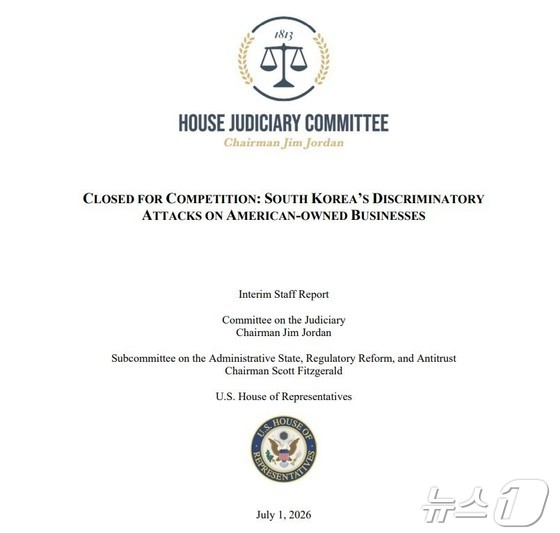
The U.S. House Judiciary Committee has released a report alleging discriminatory treatment of American companies like Coupang, reigniting discussions about the connections between Coupang and South Korea’s National Intelligence Service (NIS).
Previously, the NIS denied any involvement, stating late last year that it had not issued any directives or orders to Coupang regarding the recovery of leaked equipment after contacting former employees in China.
However, the House now claims that Coupang and the NIS exchanged 230 phone calls and that the NIS provided instructions throughout the entire process of recovering personal data, suggesting that the debate over the truth between the two parties is likely to intensify.
U.S. House: 230 Calls Between NIS and Coupang Over Three Weeks
On Wednesday, the U.S. House Judiciary Committee released a report titled, Discriminatory Attacks on U.S. Owned Companies in Korea: A Broken Competition, highlighting that despite the NIS’s involvement in the data recovery process, it imposed excessive fines and engaged in discriminatory practices against Coupang.
The report specifically stated that between December 1 and 26, the NIS made over 230 phone calls to Coupang and held several face-to-face meetings to discuss unauthorized access to Coupang’s data system by former employees and to plan recovery efforts.
It further noted that throughout these conversations, the NIS provided directions on Coupang’s actions, including the specific content and tone to use in emails sent to the former employee involved in the data leak. The report added that the NIS repeatedly instructed Coupang not to discuss the recovery operation with the police or other government agencies.
This marks the first time that the number of calls between the NIS and Coupang has been revealed in the ongoing controversy over their self-investigation.
The House also claimed to have obtained documents such as NIS official communications and call records, asserting that the NIS directed everything from contacting the leaker to the list of questions for the leaker, equipment recovery, and fingerprint collection.
Previously, Coupang stated that it had contacted former employees over two days in December to recover personal data, claiming it stored only 3,000 pieces of information, not 30 million, before deleting it.
Coupang asserted that the Korean government had directed and collaborated in this process. This unilateral statement from a company under investigation drew significant criticism.
The NIS, identified as a government agency in Coupang’s announcement, also refuted these claims.
Last December, the NIS stated that they’re not in a position to give any directives to Coupang, and there is no evidence that it did so. However, it recognized the large-scale information leak by foreigners as a national security threat and conducted work consultations for relevant information collection and analysis.
Cooperation Issue Raises Questions About 624.7 Billion KRW Fine
The South Korean government (Interagency Task Force) had previously announced it would transparently investigate Coupang’s claims that the government directed personal data recovery last December.
However, no announcements have yet been made regarding the recovery process involving the former Chinese employees.
As a result, the revelation that Coupang employees and the NIS exchanged 230 calls may become a significant point of contention.
Even if these interactions were merely for business consultations or requests, the three-week duration raises the possibility that, as the U.S. House claims, the Korean government participated in contacting the leakers and recovering personal data.
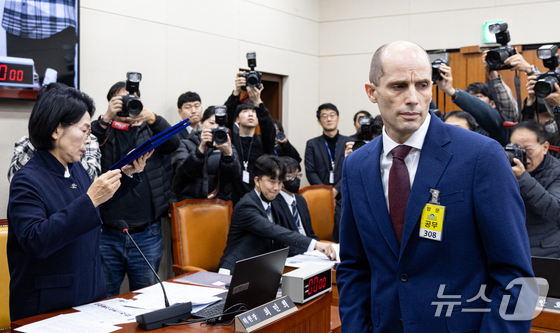
The report noted that Harold Rogers, Coupang’s Chief Executive Officer (CEO), testified that if he did not think directives from the NIS were necessary, he would never have allowed Coupang’s Korean employees to act essentially as NIS agents in China. The report emphasized that this testimony, along with documents obtained by the Judiciary Committee and the subcommittee, directly refutes the Korean government’s position.
Some speculate that this report could bring into question the appropriateness of the 624.7 billion KRW (about 404 million USD) fine imposed on Coupang for the data leak.
An industry insider remarked that Coupang did not receive credit for its efforts to recover personal data during the fine calculation process, resulting in a larger fine. Compared to the government’s ‘Everyone’s Startup’ program, where business ideas were leaked, there are voices arguing that this is inequitable. They added that the repercussions from the U.S. report may reignite the debate over the fairness of the fine.
Meanwhile, the U.S. House claimed in the report that following Coupang’s announcement of personal data recovery, various government investigations, regulations, and fines have harmed both investors and American consumers.
The report stated that Coupang’s market capitalization dropped by 40% following the Korean government’s actions, analyzing that the Korean government’s discriminatory measures against Coupang have garnered significant attention in the U.S.