

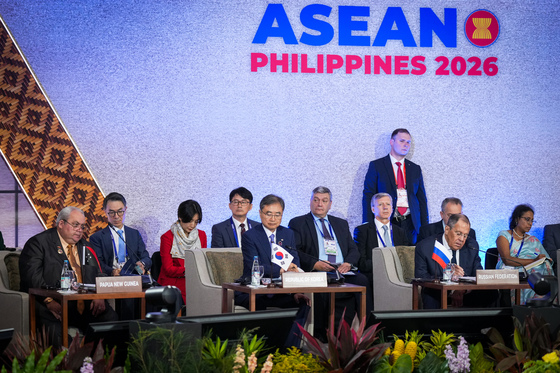
South Korean Foreign Minister Cho Hyun on Wednesday urged North Korea to respond to Seoul’s efforts to resume dialogue and cooperation during the ASEAN Regional Forum (ARF), the only multilateral regional security forum attended by both Koreas.
Cho, who is visiting Manila for ASEAN-related foreign ministers’ meetings, attended the ARF Foreign Ministers’ Meeting, the East Asia Summit (EAS) Foreign Ministers’ Meeting, and the Republic of Korea-Mekong Foreign Ministers’ Meeting. During the meetings, he reaffirmed Seoul’s commitment to restarting inter-Korean dialogue and outlined South Korea’s positions on key regional issues, including freedom of navigation in the South China Sea and the Strait of Hormuz.
At the 33rd ARF Foreign Ministers’ Meeting, Cho discussed regional and international security issues and stressed the importance of peace and stability on the Korean Peninsula.
The ARF brings together 27 countries, including South Korea, North Korea, the United States, China, Japan and Russia, to discuss political and security issues in the region. North Korea did not attend the forum for a second consecutive year.
Cho praised the ARF’s longstanding role in promoting confidence-building, preventive diplomacy, dialogue and cooperation, and expressed South Korea’s support for the Manila Plan of Action (2026-2036), a new 10-year roadmap for regional cooperation adopted at the meeting.
He also highlighted South Korea’s upcoming role as co-chair of the ARF Inter-Sessional Support Group (ISG) in 2027 and co-chair of the ARF Inter-Sessional Meeting on Counter-Terrorism and Transnational Crime (ISM on CTTC) from 2027 to 2029. He reaffirmed Seoul’s commitment to strengthening regional security cooperation, including co-hosting a workshop later this year with the Philippines and the United States on combating illegal, unreported and unregulated (IUU) fishing.
Regarding the Korean Peninsula, Cho said, “Peace and stability on the Korean Peninsula are essential for regional security and prosperity.”
“Our government has consistently worked toward a Korean Peninsula where both sides coexist peacefully and grow together,” he said. “These efforts cannot succeed through the will of only one side. We hope North Korea will respond to our government’s sincere efforts toward dialogue and cooperation.”
Cho added that he hopes the ARF, the only regional multilateral security forum in which both Koreas participate, can play a constructive role in promoting peace and stability on the Korean Peninsula. However, North Korea again skipped the meeting this year, following its absence in 2024, signaling its continued lack of interest in multilateral diplomacy involving South Korea, the United States and Japan.
Meeting participants expressed concern over North Korea’s continued development of nuclear weapons and ballistic missiles. They also emphasized the importance of denuclearizing the Korean Peninsula, complying with U.N. Security Council resolutions, encouraging North Korea’s return to dialogue and reducing tensions in the region.
The meeting also addressed a wide range of regional security issues, including the Korean Peninsula, the South China Sea and the situation in Myanmar. Many participants stressed the importance of maintaining a rules-based international order and resolving disputes through dialogue.
A chairman’s statement summarizing the meeting will be adopted after member states finalize negotiations on the text. It is expected to be released as early as Thursday or within the next several days.
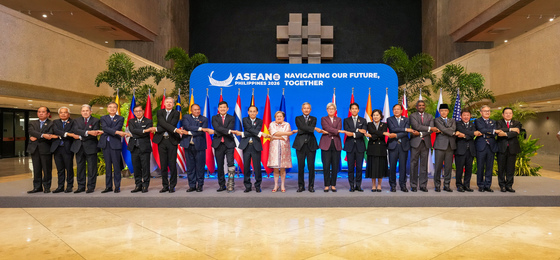
At the 16th EAS Foreign Ministers’ Meeting later that day, Cho said South Korea would “continue efforts with patience to resume dialogue with North Korea” to achieve peaceful coexistence and shared prosperity on the Korean Peninsula. He also called on EAS member states to continue supporting diplomatic efforts to resolve Korean Peninsula issues.
Participants expressed concern over North Korea’s ongoing nuclear and missile programs while agreeing that issues on the Korean Peninsula should be resolved through dialogue and diplomacy.
The EAS is a leaders-led strategic forum comprising the 10 ASEAN member states along with South Korea, the United States, China, Japan, Russia, India, Australia and New Zealand.
Cho stressed that freedom of navigation and overflight in the South China Sea must be protected and that maritime order should be based on international law, including the U.N. Convention on the Law of the Sea (UNCLOS). He added that negotiations on a Code of Conduct (COC) for the South China Sea should comply with international law and not undermine the rights of third parties.
Regarding renewed tensions surrounding the Strait of Hormuz, Cho voiced concern and emphasized that freedom and safety of navigation must be guaranteed in all international waters, including the strategically important waterway.
On Myanmar, he reiterated South Korea’s support for ASEAN’s Five-Point Consensus, which calls for an end to violence and dialogue among all parties, and pledged continued humanitarian assistance to help improve conditions in the country.
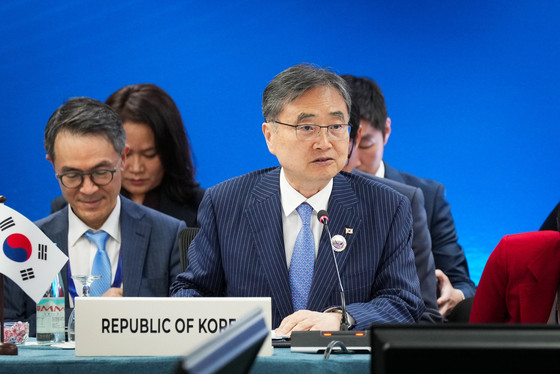
Cho also co-chaired the 14th Republic of Korea-Mekong Foreign Ministers’ Meeting with Thai Deputy Prime Minister and Foreign Minister Maris Sangiampongsa.
Marking the 15th anniversary of Korea-Mekong cooperation, South Korea, Thailand, Cambodia, Laos, Myanmar and Vietnam agreed to expand collaboration over the next five years in digital transformation, climate resilience and green transition, and smart agriculture and rural development. The agreement was adopted in a joint co-chairs’ statement.
Cho pledged continued support for the Mekong region’s sustainable development and efforts to reduce development gaps through South Korea’s official development assistance (ODA) and the Korea-Mekong Cooperation Fund (MKCF). South Korea has contributed more than $40 million to the fund between 2013 and 2025.