


“Our top priority this year and next is securing licensing deals. The goal is to create a virtuous cycle where capital generated from out-licensing our pipelines is reinvested into developing new early-stage assets.”
With that strategy, Pharos iBio is accelerating its global business development efforts by leveraging its artificial intelligence (AI)-powered drug discovery platform. The company is focusing on therapies for rare and intractable diseases while expanding partnerships across the United States and Europe to speed commercialization.
In a recent interview with News1, Kim Gyu-tae, President of Pharos iBio, said the company’s lead pipeline, including its leukemia treatment candidate, is steadily advancing through clinical development.
“Our most important objective is generating business development achievements through licensing-out,” Kim said.
Pharos iBio uses its proprietary AI drug discovery platform, Chemiverse, to identify novel drug candidates. Its business model centers on advancing candidates through early clinical development before licensing them to global pharmaceutical companies in exchange for upfront payments, milestone payments, and future royalties.
The company expects this model to create a self-sustaining funding cycle by financing future research and development with proceeds from previous licensing agreements.
The U.S. and Europe are currently Pharos iBio’s primary target markets. According to Kim, expedited regulatory pathways such as the U.S. Food and Drug Administration’s Breakthrough Therapy designation and the European Medicines Agency’s PRIME program make those regions particularly attractive for rare disease drug development.
“During discussions with potential global partners, we’ve found that regulatory strategies involving both the Korean Ministry of Food and Drug Safety and regulators in the U.S. and Europe are essential,” Kim said. “It’s important to design a global regulatory strategy from the earliest stages of development.”
The company believes its lead acute myeloid leukemia (AML) candidate, PHI-101, could qualify for these accelerated approval pathways.
Patients whose disease returns after standard treatment have few remaining treatment options, representing a significant unmet medical need and making the program a potential candidate for expedited review or conditional approval.
“For relapsed patients, there are very few effective alternatives,” Kim said. “This is exactly the type of area where breakthrough designation or conditional approval programs are designed to help.”
Securing global partnerships remains another major priority.
If Pharos iBio continues clinical development independently, the company expects to achieve proof-of-concept (POC) in approximately two years through studies conducted primarily in South Korea, Japan, and Australia.
However, partnering with a global pharmaceutical company could significantly expand clinical trial sites across the U.S. and Europe, potentially accelerating proof-of-concept by as much as one year.
Last month, the company also held multiple business development meetings with global pharmaceutical companies during the BIO International Convention in San Diego. While no agreements have yet been finalized, several discussions have progressed into follow-up negotiations.
AI Drug Discovery Platform Drives Long-Term Growth
Pharos iBio’s long-term growth strategy remains centered on expanding and enhancing its AI platform.
The company recently secured support through projects sponsored by South Korea’s Ministry of Health and Welfare and the Korea Drug Development Fund (KDDF), while also launching collaborative research with Kolon Pharmaceutical, reinforcing confidence in its platform technology.
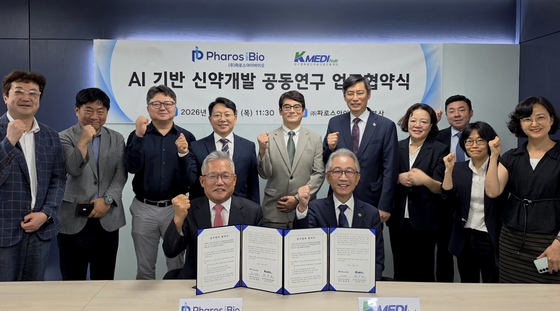
More recently, Pharos iBio signed a memorandum of understanding (MOU) with the Daegu-Gyeongbuk Medical Innovation Foundation (K-MEDI hub) to jointly conduct AI-based drug discovery research.
Its proprietary Chemiverse platform has also been upgraded to Chemiverse 2.0, incorporating new agentic AI capabilities to further improve drug discovery efficiency.
“Compared with when we went public in July 2023, the platform has evolved significantly,” Kim said. “Our expansion strategy is to continuously discover new drug candidates by leveraging advances in AI technology.”
He added that the company’s long-term research focus will remain on biomarker-driven therapies for rare and difficult-to-treat diseases.
“Rare diseases generally offer higher clinical success rates and benefit from regulatory incentives such as orphan drug designation,” Kim said.
“Our long-term strategy is to continue advancing the platform while expanding collaborative research with external partners. By combining licensing achievements with AI platform innovation, we aim to become a global leader in AI-driven drug development.”