

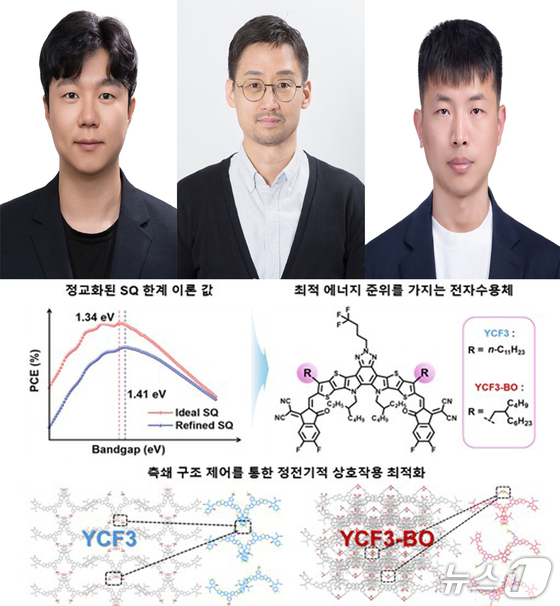
A groundbreaking study by researchers from Pohang University of Science and Technology (POSTECH) and Ulsan National Institute of Science & Technology (UNIST) has unveiled new design criteria for solar cells, potentially revolutionizing the field after 65 years.
POSTECH announced on Tuesday that the joint research team, led by Professors Cho Yong-jun and Yang Chang-deok, successfully boosted the efficiency of organic solar energy, a promising next-generation power source, by maximizing its unique properties.
The team’s findings were published in the prestigious Journal of the American Chemical Society.
While current silicon-based solar cells offer high efficiency and stability, their bulk and weight limit widespread application. The researchers’ innovative approach using organic semiconductors addresses these limitations.
This new technology allows for performance prediction during the material design phase, considering factors like light absorption and energy loss. It offers significant advantages over silicon-based cells, being thinner and lighter, which opens up possibilities for use in wearable devices and mobile energy systems.
A spokesperson for the research team highlighted the significance of their work, stating that it has successfully created organic semiconductor materials that minimize energy loss, achieving impressive photoelectric efficiency. This marks a paradigm shift from traditional trial-and-error methods to a predictive design approach, representing a major leap forward in the field.
The team believes this breakthrough will accelerate the development of next-generation flexible energy technologies, with potential applications ranging from wearable devices to building-integrated photovoltaics.