

Eli Lilly has further widened its lead over competitor Novo Nordisk with its obesity treatment Zepbound (tirzepatide, marketed as Mounjaro in some regions). After securing dominance in the U.S. market, Lilly is now flipping market shares overseas, spearheading a global reshaping of the obesity treatment landscape.
Industry reports on Friday revealed that Lilly’s second-quarter earnings, announced on Wednesday, showed a 48% year-over-year revenue increase to 23 billion USD. The pharmaceutical giant also raised its annual revenue guidance from 82-85 billion USD to 85-87 billion USD.
GLP-1 class treatments have been the driving force behind these impressive results. Sales of the diabetes drug Mounjaro skyrocketed 91% year-over-year to 9.94 billion USD, while Zepbound surpassed market expectations with sales of 4.93 billion USD. These two products alone accounted for a staggering 64.7% of Lilly’s total quarterly revenue.
In contrast, Novo’s obesity drug Wegovy generated sales of 19.48 billion DKK (about 3 billion USD). While U.S. sales declined by 22%, international sales saw a 46% uptick. Novo’s diabetes treatment Ozempic brought in 31.375 billion DKK (about 4.84 billion USD).
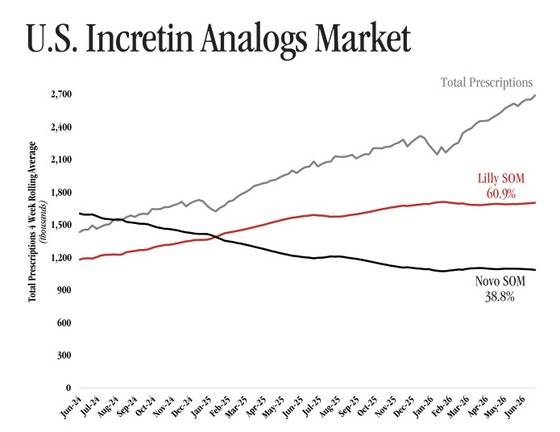
Lilly has also taken the lead in market share. The company reports that while Novo long held the advantage in the U.S. GLP-1 market, Lilly overtook them in 2025 and has been steadily widening the gap since. As of Q2 this year, Lilly commanded a 60.9% market share compared to Novo Nordisk’s 38.8% in the U.S.
Following its U.S. success, Lilly is now reshaping international markets. In regions where Novo previously dominated, Lilly has leveraged Mounjaro’s global expansion to flip market shares. Q2 figures show Lilly at 54.9% compared to Novo Nordisk’s 45.1% in markets outside the U.S.
Tirzepatide’s Superior Efficacy is Reshaping the Market Landscape
Industry analysts attribute Zepbound’s market-altering success to its outstanding effectiveness. Evan Seigerman, an analyst at BMO Capital Markets, told Reuters that the industry consensus is that tirzepatide is the superior product. Ultimately, efficacy is what matters most to consumers.
Lilly’s swift action in filling the market gap left by Wegovy’s supply shortages is also cited as a key factor in the shifting dynamics. The combination of tirzepatide’s excellent weight loss effects and Lilly’s expanded production capacity has allowed the company to seize market leadership.
Novo attempted to counter earlier this year by launching an oral version of Wegovy in the U.S., but results have fallen short of expectations. Second-quarter sales of oral Wegovy reached 3.218 billion DKK (about 495.97 million USD), a 42.6% increase from the previous quarter, but slightly below market forecasts.
Lilly’s recent price cuts for its obesity treatments, coupled with the launch of a U.S. Medicare pilot program for obesity drugs last month, have diminished Novo’s previous price advantage.
Injectable treatments continue to be preferred by patients. Lilly reports that approximately 80% of new patients in the U.S. Medicare obesity treatment pilot program opted for injectable GLP-1 therapies.
Market research firm IQVIA estimates that the global obesity treatment market reached 66 billion USD last year, with projections for the U.S. market alone to exceed 100 billion USD annually by 2030. In this rapidly expanding market, analysts suggest that Lilly is further cementing its leadership position with Zepbound and Mounjaro.