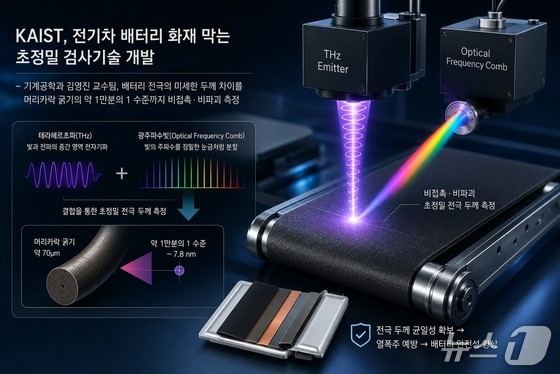
South Korean researchers have developed a groundbreaking technology that can detect minuscule thickness variations in battery electrodes—a potential cause of thermal runaway in electric vehicle batteries—without disassembling or damaging the batteries. This new method can distinguish differences as small as one ten-thousandth of a human hair’s width.
On Thursday, the Korea Advanced Institute of Science and Technology (KAIST) announced that a team led by Professor Kim Young-jin from the Department of Mechanical Engineering has created an innovative technique to measure lithium-ion battery electrode thickness with exceptional precision using non-contact, non-destructive methods.
In lithium-ion batteries, widely used in electric vehicles, electrodes are crucial components that conduct electricity. Even slight variations in thickness can cause current to concentrate in specific areas during charging and discharging, generating heat.
If this heat accumulates, it can trigger thermal runaway, underscoring the critical importance of maintaining uniform electrode thickness during battery manufacturing.
However, existing inspection technologies have faced limitations in production environments. X-ray computed tomography (CT) provides detailed internal views but is too time-consuming for fast-paced production lines. Ultrasonic acoustic microscopy requires liquid contact, while laser displacement sensors, though quick, struggle to accurately analyze electrode interiors.
The research team overcame these challenges by combining terahertz waves (THz)—electromagnetic waves between light and radio waves—to gather internal electrode data, with a frequency comb for precise reading. This innovative approach allows simultaneous measurement of electrode thickness and complex refractive index without separate calibration.
The team validated their technology on battery electrodes ranging from 50 to 150 micrometers (μm) thick, comparable to a human hair. Remarkably, in just 0.2 seconds, they could measure thickness differences down to about 1/1400th of a hair’s width—a level of precision suitable for rapid battery production lines.
Extended measurement times can increase precision up to 100-fold compared to existing time-domain analysis methods. The technology also enables three-dimensional (3D) visualization of electrode thickness and real-time tracking of thickness changes during production. Notably, it maintains accuracy even when electrodes are tilted at approximately 45 degrees.
This breakthrough is expected to play a crucial role in the production of next-generation solid-state batteries.
The research team anticipates on-site implementation after further validating the technology’s robustness in real production environments, expanding its application to various electrode compositions and solid-state battery materials, and miniaturizing the equipment.
Professor Kim emphasized that this technology represents an integrated measurement platform capable of simultaneously assessing electrode thickness and material properties without separate calibration. It expects it to become a cornerstone for real-time quality control in the production of both next-generation lithium-ion and solid-state batteries.
The research findings, with Dr. Kang Gu-sun from KAIST as the lead author and Professor Kim as the corresponding author, have been published in the prestigious scientific journal Nature Communications.