

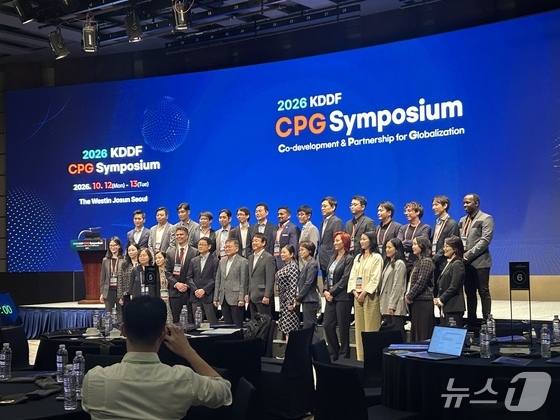
Park Young-min, head of the Korea Drug Development Fund (KDDF), emphasized the critical role of global partnerships in transforming promising research into tangible drug developments. He stressed that domestic biotech firms must secure development capabilities and explore new business opportunities through collaborations with global pharmaceutical companies to successfully commercialize their technologies.
On Monday, KDDF hosted the 2026 KDDF CPG Symposium at the Westin Chosun Seoul. The event attracted representatives from major pharmaceutical companies like Boehringer Ingelheim, Astellas, and Bayer, who shared their external innovation strategies and collaboration success stories.
In his opening address, Park stated that to turn promising scientific discoveries into successful medicines, it needs robust global partnerships and capabilities. It hopes this dialogue fosters understanding between Korean biotech companies and global partners, paving the way for new collaborations and concrete results.
The presentations highlighted how global pharmaceutical companies scout for external technologies and outlined key preparatory steps for domestic biotech firms seeking collaborations.
Fei Shen, head of U.S. business development and licensing (BD&L) at Boehringer Ingelheim, outlined various external innovation pathways, ranging from early-stage investments to the acquisition of candidate substances. Boehringer Ingelheim has been actively expanding its external collaborations, including a joint development and licensing agreement with Korean firm Aimed Bio for antibody-drug conjugates (ADCs).
Shen emphasized that science knows no borders, revealing that they are seeking collaboration partners globally, including in Korea. He underscored that scientific potential and technical compatibility take precedence over a company’s geographical location.
Minoru Kameda, head of technology scouting and transactions at Astellas, explained their approach to identifying promising treatments by considering disease biology and unmet patient needs. He highlighted the flexibility in designing collaboration agreements tailored to partners’ needs and development stages, unbounded by conventional structures.
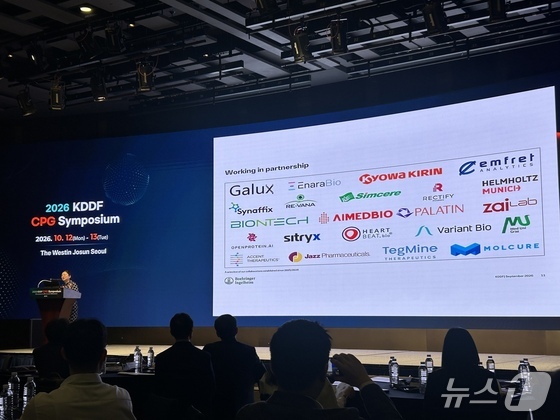
Kameda also noted that they offer comprehensive support throughout the collaboration process, from research and development to medical, manufacturing, and commercialization phases. He stressed that deal structures can be customized based on partners’ requirements, indicating that contract terms may vary depending on the development stage of candidate substances and collaboration objectives.
Consequently, domestic companies must not only showcase their technologies but also demonstrate how global pharmaceutical firms can integrate these technologies into their pipelines and the potential value creation through collaboration.
The symposium also addressed the importance of differentiated strategies and investment readiness in response to global market shifts. For early-stage companies, merely presenting technological potential is insufficient; they must articulate their unique strengths, provide clinical evidence, and outline funding requirements to stand out from competitors.
Paul Park, founder and head of strategy and corporate development at Elevare Ventures, emphasized that early-stage companies must clearly demonstrate their distinctive strengths to convince investors and partners.
He advised that even with promising technology or product results, you must explicitly present your differentiation and commercialization potential. This is particularly crucial in challenging funding environments, where objectively showcasing a company’s competitiveness is vital.
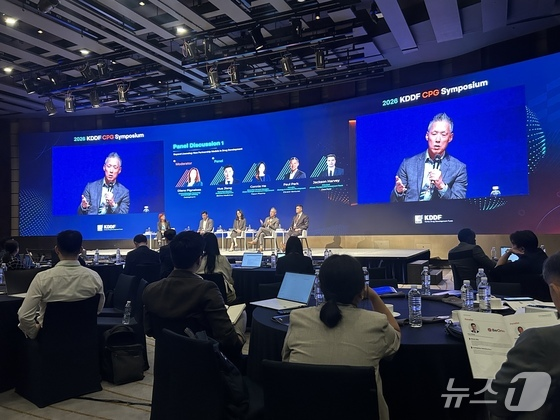
This underscores the need for domestic companies to not only highlight their technological prowess but also establish clear development milestones, present robust clinical evidence, and outline comprehensive funding strategies in the current constrained investment climate. The ability to articulate a company’s competitive edge from the perspective of global partners and investors can significantly enhance the prospects for successful collaborations and investment attraction.
As part of the symposium, KDDF is facilitating pre-matched one-on-one partnering sessions between domestic drug developers and global pharmaceutical and biotech firms. This initiative provides a platform for participants to directly engage with global business development representatives, present their candidate substances and technologies, and explore potential collaborations.