

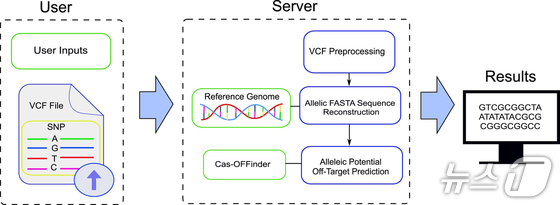
Researchers at Pusan National University have achieved a breakthrough in personalized gene editing. The team has developed a cutting-edge tool that predicts potential side effects of gene-editing techniques by analyzing individual deoxyribonucleic acid (DNA) variations.
Professor Park Jeong Bin’s team from Pusan National University’s Department of Biomedical Convergence Engineering unveiled their groundbreaking web-based tool. Developed in collaboration with Professor Kim Hye-ran from Kangwon National University’s Department of Biological Science, this innovative system predicts the precise action sites and potential off-target effects of gene-editing tools based on individual genomic variations.
The newly developed tool generates a customized DNA map from user-inputted genomic data. This map pinpoints where gene-editing tools will operate accurately and identifies potential sites for unexpected side effects.
The research team conducted extensive tests on human genomes and various pepper cultivars to validate the tool’s effectiveness. Their findings revealed distinct off-target patterns based on individual DNA differences. The tool identified unique off-target locations that were previously undetectable using existing methods.
With support for 557 species and 40 gene-editing technologies, this versatile tool has wide-ranging applications from human therapies to crop improvement.
Professor Park likened the tool to a custom navigation system for gene-editing technologies. He explained that by guiding users to safe locations tailored to individual DNA characteristics, they can minimize side effects in gene therapy while maximizing its effectiveness. He further noted that this advancement brings us closer to the era of personalized precision medicine.
The research was supported by various institutions, including the Rural Development Administration’s New Breeding Technology Development Project and the National Reseach Foundation of Korea’s (NRF) Mid-carrer Research Grant Program and Bio & Medicial Technology Development Program, and support from BK21 Four’s Training Leaders in the 4th Industrial Revolution in the Southeastern Region of Korea. Professor Park was the corresponding author, with Abiyot Melkamu Mekonnen and Seonggang Researcher as co-first authors, and Professor Kim from Kangwon National University co-author.
The groundbreaking findings were published online on May 8 in the prestigious journal Nucleic Acids Research, marking a significant milestone in gene editing and personalized medicine.