

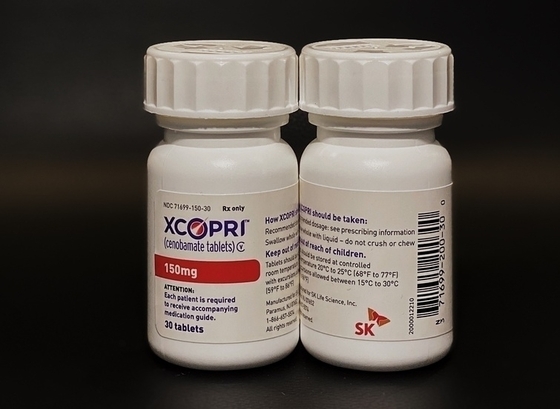
SK Biopharmaceuticals’ epilepsy drug Cenobamate (marketed as Xcopri in the U.S.) is poised for continued growth in the latter half of the year.
The medication’s upward trajectory is fueled by a resurgence in U.S. prescriptions, coupled with multiple growth catalysts including direct-to-consumer advertising (DTC), expanded indications, diversified formulations, and entry into Asian markets.
Industry reports from Monday reveal that Cenobamate’s U.S. sales hit a record-breaking 224.4 billion KRW (about 158 million USD) in Q2, marking a 45.6% year-over-year increase and a 13.5% quarter-over-quarter rise. This represents the highest quarterly revenue since the drug’s U.S. launch.
U.S. prescriptions are also rebounding strongly. After a slight dip in Q1 due to fewer business days, total prescriptions (TRx) surged to 49,155 in June – the highest level this year. The company launched a fresh DTC campaign in June to boost brand recognition and attract new patients.
Cenobamate has carved out a significant niche in the U.S. market, backed by superior clinical data compared to rival drugs. Its standout performance in achieving complete seizure freedom has garnered increasing support from healthcare providers.
In the U.S., strategic marketing efforts aimed at prioritizing prescriptions have steadily enhanced the drug’s brand recognition.
Market analysts project Cenobamate’s growth momentum to continue through the second half of the year. The full impact of the new DTC campaign, combined with ongoing healthcare professional (HCP) marketing, is expected to drive further prescription growth.
As a result, Cenobamate’s U.S. sales for the year may reach or surpass the upper end of the company’s guidance range of 780-820 billion KRW (about 551-579 million USD).
SK Biopharmaceuticals is actively pursuing expanded indications for primary generalized tonic-clonic seizures (PGTC) and conducting global Phase 3 trials for partial seizures in patients aged 2-17. These potential expansions could significantly broaden the eligible patient population, further enhancing the drug’s market position.
The company is also accelerating its formulation diversification efforts. In April, SK Biopharmaceuticals submitted a new drug application (NDA) to the U.S. Food and Drug Administration (FDA) for an oral suspension formulation targeting adult patients with partial seizures. This liquid form aims to improve accessibility for patients who struggle with tablets and allow for more flexible, personalized dosing.
Expansion beyond the U.S. market is gaining momentum. SK Biopharmaceuticals has already launched Cenobamate in South Korea and China, with Japanese approval anticipated by year-end. Leveraging its proven success in the U.S., the company is poised to strengthen its long-term growth prospects by penetrating key Asian markets.
Kim Seung-min, an analyst at Mirae Asset Securities, forecasts Cenobamate’s U.S. sales to reach 830 billion KRW (about 586 million USD) this year, exceeding the company’s upper guidance. He identifies key future catalysts as FDA approval of the suspension formulation, supplemental NDAs for PGTC and pediatric indications, and regulatory approval in Japan.