

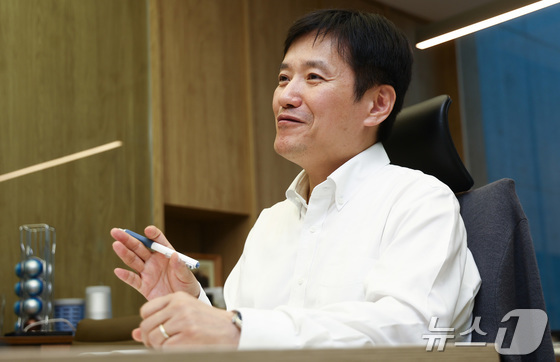
YiPSCELL, a regenerative medicine company specializing in induced pluripotent stem cells (iPSCs), is making significant strides in its clinical research for the cartilage cell therapy candidate MIUChon. The company aims to complete its main clinical trials by November next year, potentially offering a new treatment option for patients before resorting to artificial joint surgery.
On Monday, YiPSCELL announced the presentation of one-year follow-up results from its domestic clinical research on MIUChon, an iPSC-derived three-dimensional cartilage cell therapy. The findings were shared at the 2026 Korean Society for Stem Cell Research (KSSCR) Annual Conference, held at the Swiss Grand Hotel Convention Center in Seoul on August 20-21.
During the conference’s second day, Nam Yoo-jun, YiPSCELL’s Chief Scientific Officer (CSO), led a session titled, From Bench to Business, featuring industry speakers. Nam introduced MIUChon’s clinical-grade manufacturing process and presented the domestic clinical research results.
iPSCs are created by introducing artificial genes into mature somatic cells, enabling them to differentiate into various body tissues, similar to embryonic stem cells. These cells possess remarkable self-renewal capabilities, making them invaluable for regenerative medicine, personalized treatments, and understanding complex diseases like cancer.
MIUChon is an allogeneic cell therapy that differentiates iPSCs into cartilage cells, forming three-dimensional spherical aggregates (spheroids) for injection into the knee joint cavity. This innovative treatment promotes cartilage regeneration without immunosuppressants, as it’s administered in a joint cavity with low immune response.
In April last year, YiPSCELL began administering MIUChon to the first patient at Seoul St. Mary’s Hospital, following approval from the Ministry of Health and Welfare and the Ministry of Food and Drug Safety’s Advanced Regenerative Medicine and Advanced Biopharmaceuticals Review Committee in 2024. This milestone marked Korea’s first clinical administration of an iPSC-based cell therapy and the world’s first use of injectable three-dimensional cartilage spheroids.
The preliminary clinical research is led by Professor Joo Ji-hyun, head of Rheumatology at Seoul St. Mary’s Hospital and YiPSCELL’s Chief Executive Officer (CEO), in collaboration with Professor Lim Ye-ri’s team from Catholic University of Korea’s College of Medicine and YiPSCELL’s research team.
Nam shared promising one-year follow-up results from three knee osteoarthritis patients treated with MIUChon. He highlighted the significance of observing structural recovery in damaged cartilage following a single joint cavity injection.
The follow-up period revealed no significant adverse reactions, confirming the treatment’s safety. Serial magnetic resonance imaging (MRI) evaluations showed gradual reduction in cartilage defect areas and recovery of cartilage thickness in previously damaged regions.
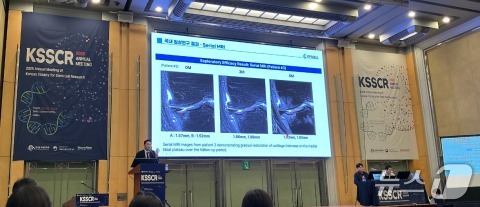
Nam cautioned that while it must interpret these results carefully, the consistent pattern of reduced cartilage defects and restored thickness over time is significant. Unlike existing treatments that merely alleviate pain, this shows MIUChon’s potential as a fundamental disease-modifying osteoarthritis drug (DMOAD) that can regenerate cartilage structure.
These findings align with YiPSCELL’s previous mechanistic studies in large animal models. Last December, the company reported increased cartilage thickness and volume, along with defect area recovery, in beagle dogs and mini pigs treated with MIUChon.
Building on the safety profile established in prior studies, YiPSCELL is currently conducting a high-risk clinical study with 30 participants, approved by the Ministry of Health and Welfare’s Review Committee last November. This randomized, double-blind, placebo-controlled study is scheduled to conclude in November next year after a one-year follow-up period.
The study aims to statistically validate structural improvements, pain relief, and functional enhancements using quantitative indicators such as magnetic resonance imaging (MRI) based cartilage volume. CEO Joo previously stated that it will thoroughly investigate whether this study can provide a new treatment option for patients before they require artificial joint surgery.
YiPSCELL is currently seeking 15 billion KRW (approximately 10.9 million USD) in Series B funding to support MIUChon’s main clinical trials completion and accelerate preparations for a KOSDAQ listing. As the first company in Korea to secure clinical-grade iPSCs based on Good Manufacturing Practice (GMP) standards, YiPSCELL is also expanding its platform-based business.
Nam emphasized that MIUChon has progressed beyond its symbolic status as Korea’s first iPSC cell therapy clinical trial and is now proving its efficacy through randomized controlled clinical trials. It plans to expedite commercialization by engaging with global regulatory agencies based on the clinical data.
In a parallel development, YiPSCELL has initiated the construction of a Next-Generation Bio Universal Autonomous Laboratory (SDL) in collaboration with six institutions, including Catholic University. This project, budgeted at 8.25 billion KRW (approximately 6 million USD), will leverage robotics and artificial intelligence to automate stem cell culture and other bio-research processes until December 2028.