

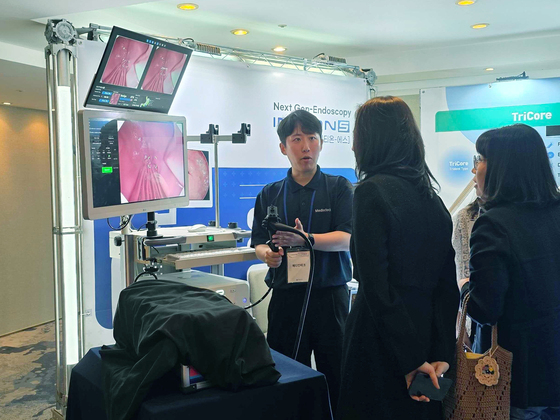
MediInTech announced on Tuesday that it showcased its clinical research and technology related to motorized endoscopes at the 2026 Pancreato-Biliary Young Leaders’ Camp held at The Westin Chosun Busan on September 11.
Earlier, at the Korean Pancreato-Biliary Association’s fall conference, the company exhibited its artificial intelligence (AI) powered robotic endoscope, INTION S, and highlighted its key features.
At this event, Professor Ryu Ji-gon from Seoul National University Hospital’s Gastroenterology Department presented on the topic Novel Motorized Endoscope for Screening EGD.
Professor Ryu has been involved in MediInTech’s motorized endoscope development and clinical research since 2021. He currently serves as the principal investigator for a government-funded advanced medical device research and development (R&D) project at Seoul National University Hospital.
During his presentation, Professor Ryu explained the operational differences between traditional mechanical endoscopes and motorized endoscopes, along with relevant clinical research findings. While conventional endoscopes require physicians to manually manipulate wheels and wires to control the endoscope tip, INTION S uses motors to guide the movement of the endoscope’s distal end.
According to MediInTech, a single-center randomized controlled trial conducted at Seoul National University Hospital in 2024 showed that the motorized endoscope performed on par with traditional mechanical endoscopes in key operability assessments.
The study revealed that medical staff experienced less physical fatigue and workload when using the motorized endoscope. These findings were published this year in the prestigious journal Scientific Reports.
In 2025, the research expanded to a multi-center randomized controlled trial involving 320 participants across five medical institutions, including Seoul National University Hospital, Seoul Metropolitan Government-Seoul National University Boramae Medical Center, Seoul National University Bundang Hospital, Severance Hospital, and Dongguk University Ilsan Hospital. Eleven endoscopists participated in the study, which evaluated examination time, operability, physician workload, patient satisfaction, and safety.
INTION S is a robotic endoscope system that automates the operation of traditional manual endoscopes. MediInTech is developing autonomous steering technology that combines motorized hardware with AI to not only analyze endoscopic images but also control endoscope movements.
The company has developed EndoTrack, which aids steering by recognizing lesions, and EndoPilot, which assists steering by identifying the direction during insertion. MediInTech plans to expand AI applications to include lesion measurement, treatment pathway planning, and assistance in therapeutic procedures.
Lee Chi-won, Chief Executive Officer (CEO) of MediInTech, stated that it will enhance the usability and reliability of the products based on data gathered from clinical settings. Additionally, it aims to expand the technology into a medical robotics platform that supports endoscopic diagnosis and treatment by integrating motorized hardware with AI.
Lee, the company’s founder, graduated from Seoul National University’s Department of Mechanical and Aerospace Engineering and earned a Ph.D. in Bioengineering. He previously worked as a senior researcher at the Seoul National University Medical Research Institute and developed endoscopes at the Korea Electrotechnology Research Institute.
The global gastrointestinal endoscopy market is dominated by Japanese firms like Olympus and Fujifilm, which control about 90% of the market share. Lee is now challenging this status quo. MediInTech has grown by focusing on the development of smart flexible endoscopes that combine motorized operation with AI-powered lesion detection capabilities.