

Pharos iBio is expanding its global open-innovation efforts in artificial intelligence (AI)-driven drug development through its Australian subsidiary.
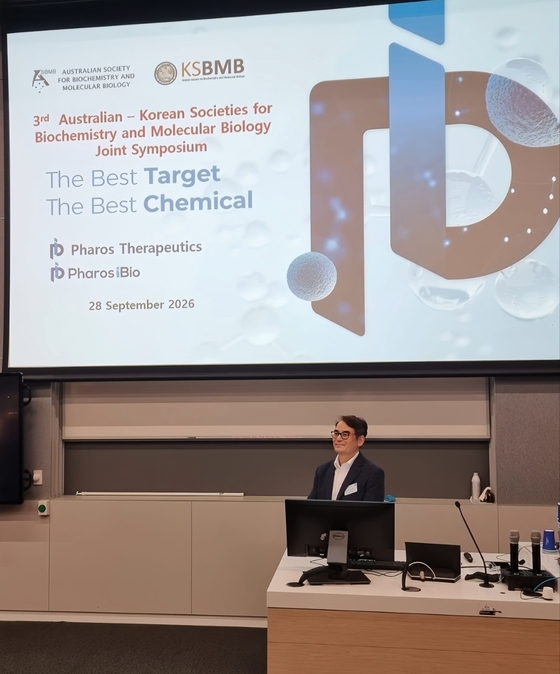
On Sept. 28, Kim Gyu-tae, president of Pharos iBio’s Australian subsidiary and chief business development officer, participated as a speaker at the third joint symposium of the Australian Society for Biochemistry and Molecular Biology (ASBMB) and the Korean Society for Biochemistry and Molecular Biology (KSBMB) at the University of Sydney, the company said on Sept. 29.
The symposium was held in conjunction with ComBio 2026, a global life sciences conference. Researchers and biotechnology industry professionals from South Korea and Australia gathered to share research findings and technology trends and discuss opportunities for bilateral collaboration.
During the “Industry Collaboration” session, Kim introduced Pharos iBio’s AI drug development technologies and global business development strategy. He highlighted the company’s open-innovation approach, which uses its proprietary AI drug development platform and R&D capabilities to expand collaborative research with pharmaceutical and biotechnology companies and research institutions in South Korea and overseas.
Pharos iBio established its Australian subsidiary in 2019 and subsequently received approval from Australia’s Therapeutic Goods Administration (TGA) to conduct a Phase 1 clinical trial of rasmotinib (PHI-101), its investigational treatment for acute myeloid leukemia (AML). PHI-101 was also granted orphan drug designation by the U.S. Food and Drug Administration (FDA) that same year.
The company currently operates its Australian subsidiary at the University of Sydney, using it as a hub for research and clinical development of rasmotinib and other drug-development programs, as well as for joint projects with local research institutions. It is also conducting collaborative research and clinical activities with organizations including the Australasian Leukaemia & Lymphoma Group (ALLG), Peter MacCallum Cancer Centre, the Walter and Eliza Hall Institute of Medical Research (WEHI), and the Children’s Cancer Institute Australia (CCIA).
Beginning this year, Pharos iBio has been pursuing its “Pharos iBio 2.0” strategy, which combines internal research capabilities with expanded external collaboration. Last month, the company signed a definitive joint R&D agreement with Kolon Pharmaceutical for PHI-701, a next-generation epidermal growth factor receptor (EGFR) inhibitor, expanding the partnership from candidate discovery through preclinical and clinical development.
“We have continued to expand our collaboration base with research institutions and biotechnology companies in Australia and the United States,” Kim said. “We will actively identify opportunities for joint research and business development in South Korea and overseas and turn global open innovation into concrete collaboration outcomes.”