

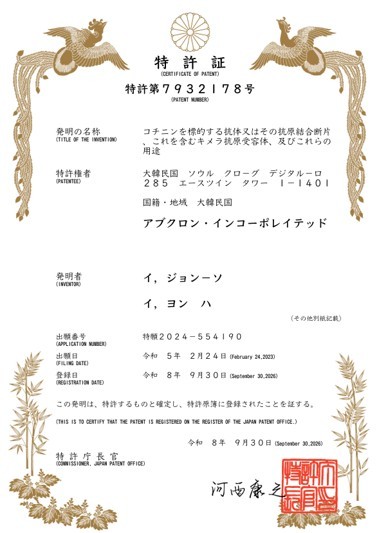
AbClon has secured a Japanese patent for its cutting-edge chimeric antigen receptor T-cell (CAR-T) therapy platform, zCAR-T, specifically for its core antibody technology. This follows the company’s earlier patent for the cancer-targeting switch molecule, strengthening its position in solid tumor treatment development and global technology transfer initiatives.
On October 16, AbClon announced the successful registration of patents in Japan for its cotinine-specific antibodies and CAR receptor technology. The company had previously secured these patents domestically, noting that this latest development solidifies their intellectual property rights for the two fundamental components of the zCAR-T platform.
The zCAR-T platform employs a switch molecule that bridges CAR-T cells and cancer cells. This molecule comprises an affibody that binds to cancer cells and cotinine, which is recognized by CAR-T cells. The newly registered patent covers antibody and CAR receptor technology that selectively identifies a specific form of cotinine.
Conventional CAR-T therapies involve administering T-cells with cancer-recognizing receptors already attached. This approach can lead to complications such as cytokine release syndrome or neurotoxicity if immune cells become overactive. Moreover, treatment efficacy may decrease if cancer cells lose their target antigens.
AbClon states that zCAR-T is engineered to modulate CAR-T cell activity by adjusting the dosage and frequency of the switch molecule. The company also aims to use a single CAR-T cell for multiple targets by altering the switch molecule based on the cancer type.
The firm is currently applying this platform to develop AT501, a solid tumor treatment candidate. Their focus is on HER2-positive solid tumors, including ovarian, gastric, and breast cancers. They’re also exploring the possibility of expanding into multi-target therapies using various switches.
AbClon has successfully registered the switch molecule patent in six countries: South Korea, the U.S., Canada, China, Australia, and Japan. The registration process is ongoing in Europe. Leveraging this newly registered receptor-related patent in Japan, the company intends to accelerate discussions for technology transfers and collaborative development with global pharmaceutical companies.
AbClon, an antibody drug development firm, was co-founded in 2010 by Chief Executive Officer (CEO) Lee Dong-seok and Professor Matthias Uhlen from Sweden’s Royal Institute of Technology. The company has been advancing new drug development and technology transfers using its proprietary platforms: NEST for antibody discovery and AffiMab for dual antibodies.
In 2015, AbClon expanded into cell therapy through a collaboration with Seoul National University on CAR-T therapies. The following year, it established a global presence by licensing the rights for a gastric cancer antibody candidate to China’s Henlius. After its KOSDAQ listing in 2017, the company ramped up its CAR-T therapy and dual antibody development efforts. Currently, AbClon is concentrating on next-generation cancer treatments, with a focus on AT101, a CAR-T therapy for blood cancers, and AM105, a dual antibody candidate.