Passengers transferring from Incheon International Airport to other cities via Los Angeles (LA) or Seattle in the U.S. will no longer need to retrieve their luggage.
The Ministry of Land, Infrastructure and Transport announced on Tuesday that it will expand a system that remotely screens luggage before arrival at U.S. airports to implement a baggage-free transfer service.
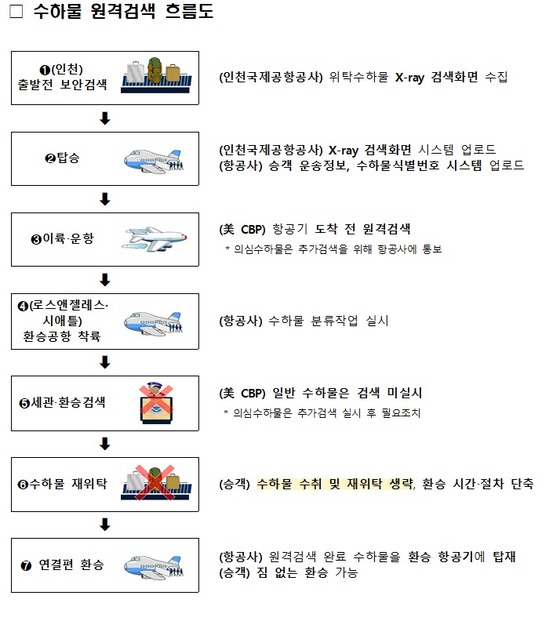
As a result, passengers departing from Incheon Airport and transferring at LA or Seattle airports will be able to board their connecting flights immediately without having to retrieve their luggage, go through customs inspection, or re-check their bags. The transfer time is expected to be reduced by about 20 minutes, from the current average of 90 minutes to around 70 minutes.
The International Remote Baggage Screening (IRBS) transmits X-ray images of baggage security screenings conducted at Incheon International Airport to the U.S., where staff at the destination airport remotely inspect the baggage during the flight and load any baggage found to be clear of issues directly onto the connecting flight.
Currently, this service is in effect for checked baggage of passengers (including transfer passengers) arriving at Atlanta, Detroit, and Minneapolis airports. Starting today, the program is being expanded to include Los Angeles and Seattle airports.
Previously, when transferring at Los Angeles (LA) or Seattle airports, baggage was not automatically transferred, so passengers had to collect their bags themselves and then go through customs inspection and random baggage opening searches. There was also the inconvenience of having to re-check baggage at the connecting airline’s check-in counter.
At Seattle Airport in particular, where passengers typically undergo immigration and customs inspections after retrieving their luggage, the elimination of the baggage retrieval step is expected to significantly enhance passenger convenience.
This measure was implemented through cooperation between the Ministry of Land, Infrastructure and Transport and the U.S. Department of Homeland Security (DHS). The two countries agreed to streamline transfer procedures and dramatically improve passenger convenience through remote screening of checked baggage using advanced aviation security technology.
Remote baggage screening applies to passengers traveling on Korean Air and Delta Air Lines who meet certain criteria set by U.S. Customs and Border Protection (CBP). It applies equally to passengers on direct flights between Incheon and Los Angeles and between Incheon and Seattle, as well as to transfer passengers at Incheon International Airport who are traveling from a third country through Incheon to the U.S.
Currently, Korean Air operates three daily flights on the Incheon–Los Angeles route (two daily flights on Tuesdays and Thursdays), while Korean Air and Delta Air Lines each operate one daily flight on the Incheon–Seattle route. Last year, the total number of passengers on these two routes was 421,000.
Of these, 127,000 passengers—accounting for 30.1%—transited through Los Angeles and Seattle airports. Transfer passengers are expected to directly benefit from shorter layover times, while arriving passengers will also be able to retrieve their luggage more quickly due to reduced customs inspection times.
Lee Sang-heon, Director General of Airport Policy at the Ministry of Land, Infrastructure and Transport, said that it expects that the expanded implementation of remote screening of checked baggage will not only enhance security through cutting-edge technology but also significantly improve passenger convenience and boost Incheon International Airport’s global competitiveness.
He added that based on mutual trust and cooperation between the two countries, it will expand the service to major airports in the U.S. and gradually increase the number of participating airlines so that more passengers can benefit from this service.