

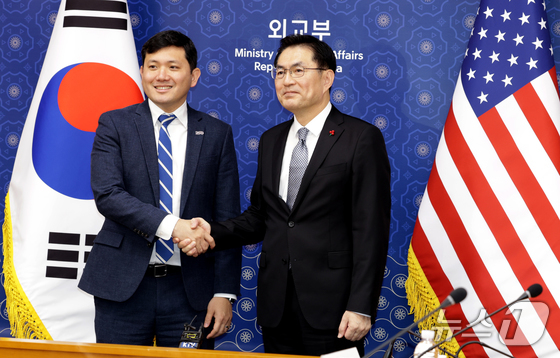
On Tuesday, the U.S. and South Korea launched regular consultations to coordinate their North Korea policies, along with a joint factsheet detailing agreements from the Gyeongju summit.
The inaugural meeting took place that morning at the South Korean Ministry of Foreign Affairs in Seoul. Jeong Yeon-du, Director-General of the Ministry’s Diplomatic Strategy and Information Bureau, and Kevin Kim, Deputy Chief of Mission at the U.S. Embassy in South Korea, led their respective delegations.
Officials from both the Ministry of Foreign Affairs and the Ministry of National Defense attended the meeting. The U.S. delegation included representatives from the State Department and the Department of Defense, notably Scott Johnson, the Pentagon’s Korea regional director, and Anthony Henderson, who oversees strategic planning and policy for U.S. Forces Korea.
The Ministry of Unification had previously announced it would not participate in these follow-up discussions, opting instead to engage with the U.S. on North Korea policy through separate channels.
This initiative aims to formalize existing diplomatic communication channels for North Korea policy coordination. The Ministry of Foreign Affairs emphasized that this does not signify the creation of a separate consultative body akin to the 2018 U.S.-South Korea Working Group.
The Ministry initially dubbed this meeting the Regular Consultation on North Korea Policy, but later rebranded it as the Follow-up Consultation on the U.S.-South Korea Joint Factsheet from the Summit. This change appears to address concerns raised by the Ministry of Unification about the Foreign Ministry’s leadership role in North Korea policy.
During this meeting, both sides are expected to focus on maximizing synergy as Seoul prepares to intensify its Korean Peninsula Peace Coexistence Process, including renewed inter-Korean dialogue starting next year.
The U.S. is reportedly considering using North Korean sanctions and human rights issues as leverage in future negotiations with Pyongyang. Consequently, discussions are likely to center on aligning this approach with Seoul’s engagement policy.
Moreover, U.S. officials may express concerns about the apparent internal divisions within the South Korean government between independent and alliance factions, which have led to inconsistencies in North Korea policy.