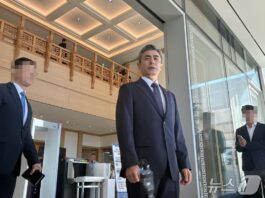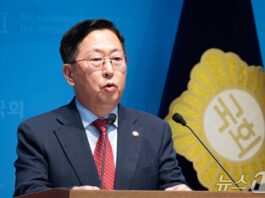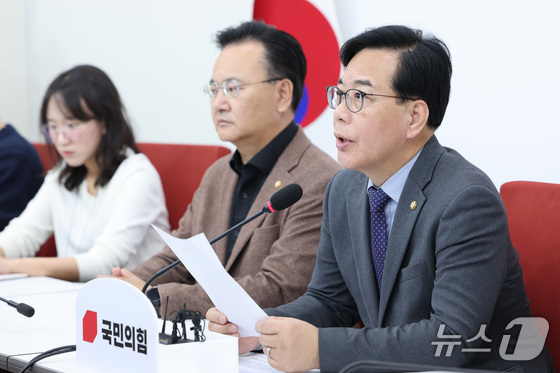
On Wednesday, Song Eon-seok, the floor leader of the People Power Party, called on President Lee Jae-myung to immediately dismiss Unification Minister Chung Dong-young. This demand came in response to the controversy sparked by Chung’s comments about North Korean nuclear facilities, which led to discussions about the U.S. potentially limiting intelligence sharing with North Korea. Song remarked that it’s hard to tell if the minister’s name is Chung Dong-young or Ri Ho-nam, highlighting the perceived alignment with North Korean interests.
During a press conference at the National Assembly, Song criticized Chung, stating that the minister has acted more like the head of North Korea’s United Front Department than South Korea’s Unification Minister. He urged President Lee to dismiss Chung promptly to mend the strained relationship between South Korea and the U.S.
Song also expressed concern about President Lee Jae Myung’s actions, noting that the issue is compounded by President Lee once again resorting to social media from India to provide remote support. He added that some are questioning whether Lee is deliberately escalating tensions with the U.S. to appease China and North Korea.
Song emphasized that the priority should be addressing the restrictions on U.S.-South Korea intelligence sharing, rather than protecting a single minister.
The floor leader pressed the government for answers on several key points, including whether the Commander of U.S. Forces Korea visited the Ministry of National Defense on March 10 and met with Defense Minister Ahn Gyu-back to discuss Chung’s remarks.
He also inquired about a potential follow-up visit by the commander and whether U.S. Deputy Assistant Secretary of State Michael Desombre raised objections during his visit to Korea on March 11. Song demanded full transparency from both the Defense and Foreign Affairs ministries on these matters.
Addressing Minister Chung’s explanation that the nuclear facilities information was already public knowledge through the Institute for Science and International Security (ISIS) reports and media coverage, Song argued that regardless of its veracity, such statements were irresponsible coming from a minister.
He asserted that ministers should only discuss officially recognized information, maintaining a responsible government stance. Song warned that official acknowledgment of military secrets by high-ranking officials is tantamount to disclosing classified information.
While acknowledging that many experts view North Korea as a de facto nuclear state, Song stressed that it’s inappropriate for a government minister to make such declarations, highlighting the crucial difference between private sector opinions and official government positions.
Song also called for a significant shift in the Lee administration’s real estate policies. He advocated for easing loan regulations for first-time buyers and actual residents to normalize market entry. He urged the government to retract policies that have increased market instability, such as the proposed abolition of long-term holding tax exemptions and increased property taxes, and to apologize for the resulting public confusion.
The floor leader pushed for reforms in the tax structure, moving away from transaction-based taxes. He proposed bold strategies to increase housing supply in Seoul, including streamlining reconstruction and redevelopment processes, promoting urban multi-family housing redevelopment, and easing restrictions in areas affected by Seoul Airport.
Song outlined plans to facilitate the construction of 310,000 housing units by 2031, including 198,000 units along the Han River belt. He promised to work with Seoul Mayor Oh Se-hoon to implement these ambitious supply expansion policies and simplify approval procedures.
In conclusion, Song emphasized that real estate policies should prioritize people’s lives over ideology. He strongly urged the Lee administration to abandon its confrontational approach to the market and adopt a balanced policy that focuses on the needs of actual residents.