

North Korea’s Foreign Ministry has launched a series of scathing criticisms against South Korea, the U.S., and Western nations through three statements over two days. Analysts interpret this as a sensitive reaction to recent discussions between South Korea and the U.S., as well as South Korea and Europe, which touched upon North Korea’s denuclearization. It appears that North Korea is engaging in aggressive diplomacy to strengthen its position as a nuclear power, as observed on June 14.
In a statement released that morning, a spokesperson for the Foreign Ministry responded to the recent U.S.-South Korea Nuclear Consultative Group (NCG) meeting and the U.S.-Japan Extended Deterrence Dialogue (EDD), which reaffirmed the commitment to pursue North Korea’s denuclearization. The spokesperson declared that the meaningless anti-North Korea rhetoric and nuclear threat coordination from the U.S. and its followers will have no impact on the irreversible status as a nuclear power.
The spokesperson also asserted the legitimacy of North Korea’s nuclear arsenal, stating that its nuclear shield development is a lawful process aimed at deterring external interference and threats, safeguarding the national sovereignty and security, and ensuring regional peace and stability.
They emphasized that regardless of the arguments put forth by the U.S., Japan, and South Korea that they will never alter the current status of the Democratic People’s Republic of Korea as a nuclear power, insisting that no one can resurrect the permanently lost concept of denuclearization from the annals of history.
This statement marks the third official position from the Foreign Ministry, following comments from the Director of the Ministry’s Department of Foreign Policy and a spokesperson from the Ministry’s 10th Bureau the previous day. In those earlier statements, North Korea targeted the recent U.S. approval of the foreign military sale (FMS) of 70 AIM-120C-8 Advanced Medium-Range Air-to-Air Missile (AMRAAM) missiles and two AMRAAM guidance sections to South Korea, as well as the agreement to maintain a diplomatic stance on North Korea’s denuclearization in the joint statement from the South Korea-European Union (EU) summit. With strengthening ties with Russia and restored close relations with China, North Korea appears determined to demonstrate its resilience against U.S. and Western pressure.
North Korea Secures Backing for Aggressive Messaging; Possible Consideration of U.S. Talks Premised on Nuclear Power Status
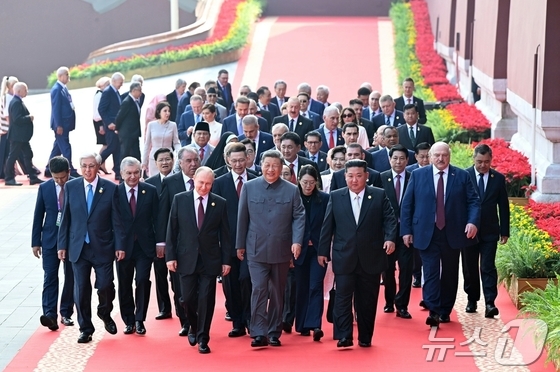
This latest statement, coming after the North Korea-China summit on June 8-9, is particularly noteworthy. China’s decision not to address North Korea’s nuclear issues while emphasizing the strengthening of strategic relations with North Korea has been interpreted as elevating North Korea’s strategic position. This may have emboldened North Korea further. There also seems to be an intent to highlight the diminishing effectiveness of the denuclearization policies pursued by South Korea, the U.S., and Western nations.
During the recent North Korea-China summit in Pyongyang, Chinese President Xi Jinping notably focused on developing bilateral relations and enhancing strategic communication without mentioning North Korea’s nuclear issues or demands for denuclearization, unlike in the past.
Diplomatic circles interpret this as China not officially recognizing North Korea as a nuclear power, but essentially maintaining a stable relationship based on the reality of North Korea’s nuclear status. China also unusually mentioned military cooperation between North Korea and China, indicating a desire to strengthen ties with North Korea as a strategic ally.
From North Korea’s perspective, this represents a significant achievement, securing implicit support from China on nuclear issues following Russia’s backing. The two days of pointed statements are seen as an aggressive move to reinforce its position as a nuclear power, based on this newfound confidence.
Some analysts speculate that this latest statement may be a preemptive move considering the potential for future North Korea-U.S. dialogue. Interestingly, this coincides with former U.S. President Donald Trump’s recent sharing of past summit photos with North Korea while discussing their relationship. This suggests that North Korea might be raising its demands in preparation for a potential negotiation phase.
Professor Lim Eom-chul from the Far East Institute at Kyungnam University observed that analyzing North Korea’s recent domestic and foreign actions, including the North Korea-China summit and the series of statements, it appears that Kim Jong Un’s top priority is not compromise through negotiation but rather qualitative and quantitative enhancement of nuclear capabilities. While in 2018-2019 they leveraged their nuclear weapons to increase negotiating power, now they seem to be solidifying their nuclear possession as a fait accompli and preparing for a long-term structural confrontation.
First Appearance of Foreign Ministry’s 10th Bureau Spokesperson; Reaffirmation of South Korea Affairs Channel Amid Two-State Policy
The existence of the Foreign Ministry’s 10th Bureau spokesperson was first identified through yesterday’s statement. The spokesperson condemned South Korea’s recent joint statement with the EU, which criticized North Korea’s status as a nuclear power and military cooperation with Russia, stating that South Korea remains an unchanging enemy that embodies hostility and confrontation.
The spokesperson further criticized South Korea’s previous claims of respect for the regime and non-hostile actions, labeling them as mere disguises. They asserted that South Korea is the absolute number one enemy, which cannot exist apart from hostility toward the nation.
Following the declaration of two Koreas, North Korea has restructured its specialized department for South Korean affairs, the United Front Department, into the 10th Bureau and transferred it under the Foreign Ministry rather than the Party. It has been confirmed that during the 9th Party Congress, Jang Geum-cheol, the former head of the United Front Department, was appointed as the First Vice Minister of Foreign Affairs and head of the 10th Bureau, reaffirming that this bureau is currently North Korea’s channel for South Korean affairs.