

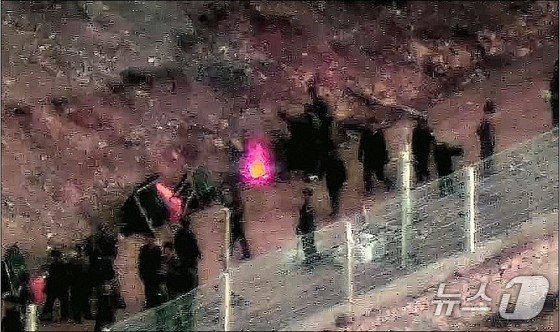
Recently, the South Korean government and the United Nations (UN) Command (UNC) have taken opposing stances regarding North Korea’s construction of fences near the Military Demarcation Line (MDL) north of the border. While the South Korean government has clearly labeled this as a violation of the armistice agreement, the UNC has stated that such border-making activities do not necessarily constitute a breach of the agreement.
The installation of barbed wire, barriers, and mines north of the MDL, along with the destruction of inter-Korean connecting roads and the creation of no-man’s land, are measures that North Korea has intensified since designating inter-Korean relations as those between two hostile states in 2023. North Korea refers to these actions as border-making measures, implying the establishment of a new border between two separate countries.
Some sections of the fence installed by North Korea are located within 100 meters north of the MDL, likely falling within the prohibition of hostile acts zone under the armistice agreement. However, the UNC, which is responsible for managing the area, has essentially taken a permissive stance on this issue.
Critics argue that the UNC is applying a double standard to the two Koreas, given that it has previously expressed negative views on South Korean proposals to share control over peaceful entry into areas south of the Demilitarized Zone (DMZ) or to jointly manage the region.
North Korean military escalates border activities, but UNC remains silent
According to reports from the office of Representative Kang Dae-sik of the People Power Party, a member of the National Assembly’s National Defense Committee, and military authorities, North Korea has recently been installing fences up to 100 meters (about 0.062 miles) north of the MDL along the entire front line. In some areas, they have reportedly completed creating no-man’s land up to 5-10 meters (about 0.003 to 0.006 miles) above the MDL and are now laying minefields to prevent defections. The fence is estimated to be 80-90 kilometers (about 49.7 to 55.9 miles) long, and about 60-70 kilometers (about 37.3 to 43.5 miles) of tactical roads are being constructed at a rapid pace.
The Ministry of National Defense stated that it considers the North Korean military’s installation of obstacles near the MDL to be a clear violation of the armistice agreement. The military respects the UNC’s responsibilities under the armistice agreement and will closely cooperate with the UNC and the U.S. to respond to North Korean military activities near the MDL. This statement suggests that North Korea’s actions violate the armistice agreement and that a response from the UNC is necessary.
The Joint Chiefs of Staff also declared that the North Korean military’s installation of obstacles near the MDL is a clear violation of the armistice agreement. Its military is closely monitoring North Korean military activities near the MDL and will continue to respond in close cooperation with the UNC.
The armistice agreement, signed in 1953 between the UNC, North Korea, and China, has been in effect since then. It prohibits all hostile acts within the demilitarized zone (DMZ), which extends 2 kilometers north and south of the MDL. For the past two years, the South Korean military has refrained from labeling North Korean border activities as violations of the armistice agreement. However, recent developments in the border area seem to have crossed a line, prompting the South Korean military to take a stronger stance in declaring North Korea’s actions as violations of the agreement. This interpretation suggests that North Korea has violated the armistice agreement’s provision establishing the DMZ as a buffer zone.
UNC Says North Korea Did Not Violate Armistice, Maintains Strict Interpretation of South Korea’s DMZ Law
In contrast, the UNC’s interpretation differs significantly from that of the South Korean military. The UNC has taken a reserved stance, stating that construction activities and fortification near the MDL do not automatically constitute a violation of the armistice agreement. The UNC stated that activities within the DMZ must be understood within the overall context. Construction activities, fortification, defensive measures, or the presence of related personnel do not automatically constitute a violation of the armistice agreement.
The UNC’s assessment can be seen as acknowledging North Korea’s claim that its series of activities are for defense rather than attack. As the organization responsible for managing the armistice agreement and communicating with both Koreas, it is presumed that North Korea has also communicated with the UNC to avoid military responses to its border-making activities. In this process, the UNC seems to have concluded that North Korea’s actions do not indicate offensive intentions. Although the Ministry of National Defense raised objections to the UNC, arguing that North Korea’s actions violate the armistice agreement, the UNC’s position reportedly remains unchanged.
Michael Bosack, former deputy secretary of the UNC Military Armistice Commission, posted on his social media account X that during his time working at the UNC, he saw no evidence that North Korean border reinforcement activities were hostile. South Korean forces also install mines and fence obstacles in the southern area. This logic appears to reflect the current stance of the UNC. Bosack served at the UNC from August 2019 to November of last year.
However, the UNC’s stance contrasts with the strict principled approach it has applied to South Korea’s efforts to implement the DMZ law. This discrepancy could potentially lead to controversy over fairness, with the UNC appearing to tolerate North Korean actions while applying stricter standards to South Korea.
Previously, the UNC strongly opposed the so-called DMZ law, which included provisions to transfer some control over non-military and peaceful entry into the DMZ to the South Korean government, arguing that it directly contradicted the armistice agreement. This opposition was notable as the UNC, which typically refrains from expressing opinions on political issues and maintains a neutral stance, took an unusually strong position against the proposal.
In response to this opposition, the Ministry of National Defense officially proposed a compromise to the U.S. earlier this year, suggesting joint management of the southern part of the DMZ by South Korea and the U.S. However, it is reported that the UNC has not yet shown any significant response to this proposal.
Critics argue that while the UNC is not taking any significant action to curb North Korea’s aggressive behavior in the border area, including its border-making measures, it is applying strict standards to South Korea’s initiatives. This situation is viewed as strange and inconsistent with the spirit of the ROK-U.S. alliance.
Yang Uk, a research fellow at the Asan Institute for Policy Studies, commented that from the UNC’s perspective, unable to inspect the northern area, they may not have a clear understanding of the level of militarization by North Korean forces through fences and other obstacles, and thus may not be in a position to judge violations. He added that however, in the MDL and DMZ regions, North Korea has generally shown an offensive attitude while South Korea has maintained a defensive posture. Therefore, from South Korea’s standpoint, it is necessary to consistently express opinions to ensure that the UNC applies consistent standards.