

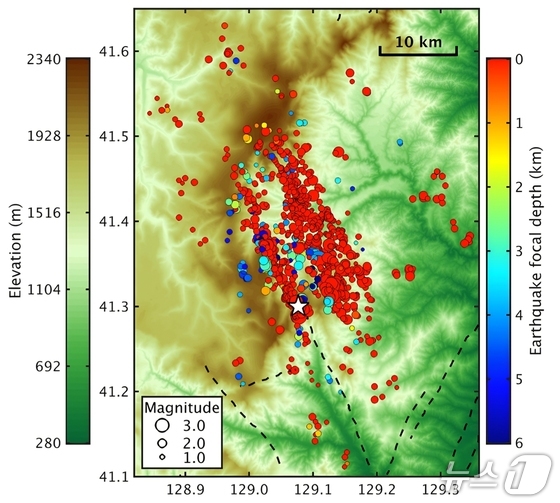
A groundbreaking study has revealed that the fault system near Mount Mantap in North Korea’s Kilju County, site of the regime’s nuclear tests, has been gradually reactivating over several years.
On Friday, researchers from Pusan National University, in collaboration with Chinese institutions including Chengdu University of Technology and the Chinese Academy of Sciences, announced their findings based on 17 years of seismic data analysis. The study, published in the prestigious journal Science, sheds new light on the long-term effects of nuclear testing.
The research team noted that conventional underground nuclear test sites, such as those in Nevada or the former Soviet Union’s Semipalatinsk, typically show a rapid decrease in seismic activity within days or weeks following detonations.
However, the area surrounding Mount Mantap, where North Korea conducted six nuclear tests between 2006 and 2017, exhibited an anomalous pattern. Following the regime’s largest test in 2017, seismic activity in the region not only persisted but continued to increase over several years.
Significantly, the study found that earthquakes were concentrated along two previously dormant northwest-trending fault lines. The team’s analysis suggests that repeated nuclear tests caused cumulative damage to the shallow crust, redistributing stress within the rock and triggering slips along pre-existing faults that were already in a critical state.
Professor Kim Kwang-hee, lead researcher from Pusan National University, emphasized the importance of these findings: The prolonged seismic activity following the nuclear tests, particularly along existing fault lines, underscores the need for long-term monitoring and analysis. This research has critical implications for verifying compliance with the Comprehensive Nuclear-Test-Ban Treaty (CTBT) and assessing the safety of underground facilities. It’s a wake-up call for the international community to remain vigilant about the lasting geological impacts of nuclear testing.