

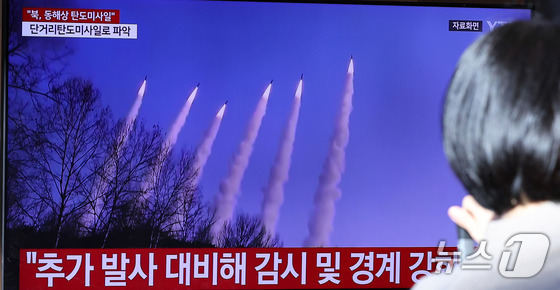
On September 20, North Korea conducted a series of provocative military actions, launching short-range ballistic missiles (SRBMs) at three-hour intervals. This marks the 14th and 15th ballistic missile tests by North Korea this year, coming just eight days after their previous launch on September 12.
The Joint Chiefs of Staff (JCS) reported that at approximately 5:50 p.m. (KST) on September 20, North Korea fired an additional short-range ballistic missile from the Wonsan area into the East Sea. The missile traveled over 600 kilometers (about 373 miles), with South Korean and U.S. forces currently conducting a detailed analysis of its specifications.
Earlier that day, around 3:00 p.m. (KST), North Korea had already launched one SRBM from the same area, which flew approximately 450 kilometers (about 280 miles). Japan’s Ministry of Defense indicated that both missiles appeared to have landed outside Japan’s exclusive economic zone (EEZ) after launch.
A JCS official stated that South Korea, the U.S., and Japan have been tracking and sharing relevant information since the initial launch. The official added that its military maintains a robust South Korea-U.S. combined defense posture, closely monitoring North Korea’s activities and standing ready to respond decisively to any provocations.
The JCS is currently analyzing the specific details of the missile launches. Defense experts suggest that these tests are likely related to the Hwasong-11 series, part of North Korea’s five-year defense development plan. The missiles, which flew 450 and 600 kilometers (about 280 and 373 miles) respectively, demonstrate a capability to potentially strike not only all of South Korea but also some U.S. military bases in Japan.
Some analysts interpret these actions as a response to recent joint military exercises, including Freedom Edge involving South Korea, the U.S., and Japan, as well as Orient Shield with the U.S., Japan, and Australia. The launches may also be a reaction to international resolutions on North Korean nuclear disarmament, including those from the International Atomic Energy Agency (IAEA).
Below is a chronological list of North Korea’s missile launches and military provocations in 2026:
▲ January 4: During President Lee Jae Myung’s state visit to China, North Korea launched several ballistic missiles into the East Sea from near Pyongyang, traveling approximately 900 kilometers (about 559 miles). North Korea claimed to have tested a hypersonic missile that flew 1,000 kilometers (about 621 miles).
▲ January 27: North Korea fired multiple short-range ballistic missiles into the East Sea from near Pyongyang, with a flight distance of about 350 kilometers (about 218 miles). North Korea asserted that four large-caliber rocket artillery pieces flew 358 kilometers (about 223 miles).
▲ March 14: Over ten ballistic missiles were launched into the East Sea from Sunan, Pyongyang, traveling approximately 350 kilometers (about 218 miles). North Korea claimed to have tested a 600mm multiple rocket launcher system that flew 364 kilometers (about 226 miles).
▲ April 7: North Korea attempted to launch an unidentified ballistic missile near Pyongyang, which disappeared shortly after liftoff.
▲ April 8: At around 8:50 a.m. (KST), North Korea fired several short-range ballistic missiles into the East Sea from the Wonsan area, with a flight distance of 240 kilometers (about 149 miles).
▲ April 8: At approximately 2:20 p.m. (KST), North Korea launched another short-range ballistic missile into the East Sea from Wonsan, which flew about 700 kilometers (about 435 miles). North Korea claimed to have tested a cluster munitions-equipped Hwasong-11 variant.
▲ April 19: Multiple short-range ballistic missiles were fired into the East Sea from the Sinpo area in South Hamgyong Province, traveling about 140 kilometers. North Korea asserted it tested five tactical ballistic missiles, dubbed Hwasongpo-11R, equipped with cluster munitions, flying 136 kilometers (about 84.5 miles).
▲ May 26: North Korea launched close-range ballistic missiles (CRBMs) into the West Sea from the Jeongju area in North Pyongan Province, with a flight distance of 80 kilometers (about 50 miles). North Korea claimed to have tested CRBMs, extended-range 240mm guided rocket artillery, and artificial intelligence (AI)-equipped tactical cruise missiles.
▲ June 25: North Korea claimed to have tested extended-range 240mm rocket artillery, ballistic missiles with special warheads, and 155mm self-propelled artillery.
▲ August 6: A single short-range ballistic missile was launched into the East Sea from the Wonsan area.
▲ August 12: North Korea fired one short-range ballistic missile into the East Sea from Wonsan, traveling over 700 kilometers (about 435 miles).
▲ August 20: Multiple short-range ballistic missiles were launched into the East Sea from near Pyongyang, with a flight distance of about 300 kilometers (about 186 miles).
▲ September 12: Several short-range ballistic missiles were fired into the East Sea from the Wonsan area, traveling approximately 250 kilometers (about 155 miles).
▲ September 20: North Korea launched one short-range ballistic missile into the East Sea from the Wonsan area, with a flight distance of about 450 kilometers (about 280 miles).
▲ September 20: An additional short-range ballistic missile was fired into the East Sea from the Wonsan area, traveling approximately 600 kilometers (about 373 miles).