The U.S. and South Korea are set to conduct their biannual joint military exercise, Ulchi Freedom Shield (UFS), from August 17 to 27. This defensive-focused drill will also serve as a platform to evaluate the capabilities and conditions necessary for the transfer of wartime operational control (OPCON). Both nations have agreed to address the findings at the upcoming Security Consultative Meeting (SCM) scheduled for later this year.
U.S.-South Korea Joint Assessment for OPCON Transfer: Details to be Discussed at SCM
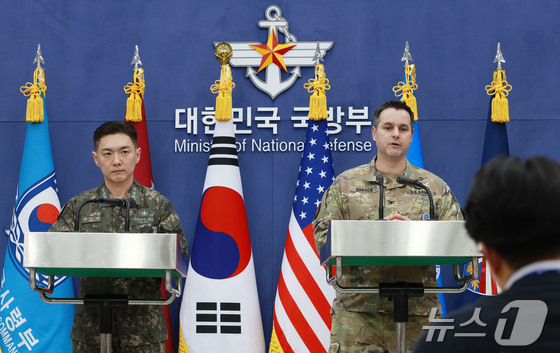
During a joint press conference with the U.S.-South Korea Combined Forces Command on Monday, the Joint Chiefs of Staff (JCS) emphasized that the exercise will strengthen the alliance’s combined defense posture by honing joint operational capabilities across all domains. The JCS also noted that this drill will further advance preparations for the agreed-upon conditions-based transfer of wartime operational control.
The JCS reported that approximately 18,000 South Korean troops will participate in this year’s UFS, comparable to previous iterations. The exercise will include activities related to the Full Operational Capability (FOC) validation, which corresponds to the second phase of evaluation.
JCS Spokesperson Maj. Gen. Jang Do-young stated that the forces will conduct a joint assessment based on mutually agreed criteria during this exercise period. He added that if it meets these benchmarks, it anticipates proposing the timeline for FOC validation of the future combined command and the transfer at the SCM. It’s fully committed to achieving this goal.
U.S. Forces Korea spokesperson Col. Ryan Donald echoed this sentiment, noting that discussions on specific evaluations, timelines, and validations are managed through the joint communication channels at the respective defense commands and will be addressed at the SCM. However, it won’t officially discuss the joint assessment and timing at this briefing.
Earlier, on August 5, the Ministry of National Defense indicated during a Blue House briefing that the OPCON transfer timeline would be determined at the SCM later this year. As the SCM typically includes reports on that year’s joint exercises, it’s expected that some evaluations related to OPCON transfer conditions will occur during the UFS.
The evaluation process consists of three phases: Initial Operational Capability (IOC), Full Operational Capability (FOC), and Full Mission Capability (FMC). After assessing and validating each phase, both nations will agree on a transition year and present it to their respective presidents.
During a regular Defense Ministry press briefing, Maj. Gen. Jang noted that in 2022, our forces successfully completed the FOC evaluation led by a South Korean four-star general, receiving high marks from both U.S. and South Korean military authorities. He added that they’re in talks with the U.S. counterparts to regularly conduct joint exercises led by a South Korean four-star general and will determine the implementation schedule following this year’s FOC validation.
Field Training Exercises Reduced from 22 to 14 During UFS; JCS Plans Year-Round Distribution
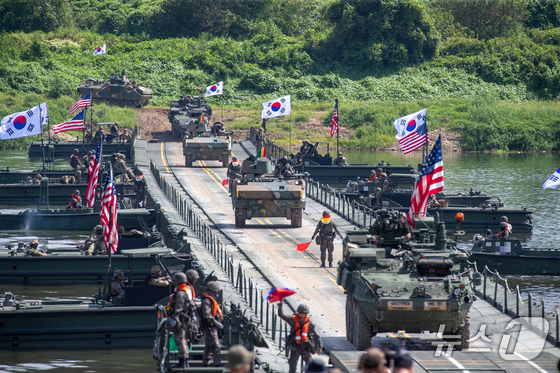
The U.S. and South Korea also announced plans to enhance combat readiness through the Warrior Shield exercise during the UFS. This field training exercise (FTX) includes river crossing drills and other maneuvers designed to improve combined operational capabilities, with participation from battalion-level units and above. The UFS is broadly divided into command post exercises (CPX) focused on simulations and FTX involving actual forces.
A JCS official explainef that the nations are integrating combined field exercises at the battalion level and above to maintain a constant state of readiness and enhance capabilities throughout the year. He added that this FTX will prioritize essential training directly linked to the exercise scenario.
This year’s UFS scenario will incorporate lessons from recent conflicts, including potential U.S.-Iran tensions and North Korea’s hypothetical involvement in the Russia-Ukraine war.
Col. Donald stated that it must acknowledge that North Korean forces’ capabilities may have evolved due to their alleged involvement in Ukraine. He noted that the training will address potential North Korean threats, including cyber and drone attacks, as well as global positioning system (GPS)-related vulnerabilities.
Moreover, the U.S. and South Korea aim to bolster national emergency preparedness by integrating government department exercises with actual training, thereby improving their whole-of-government response capabilities to ensure public safety and protection.
The exercise will also include participation from approximately 70 personnel representing United Nations Command member states. The Neutral Nations Supervisory Commission (NNSC) will observe and verify compliance with the armistice agreement.