

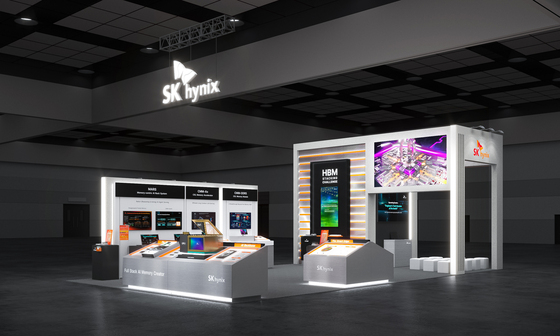
SK Hynix has unveiled the first standard specification for its next-generation storage technology, High Bandwidth Flash (HBF), in partnership with SanDisk. The company aims to expand the artificial intelligence (AI) memory ecosystem.
From August 4 to 6, SK Hynix will present the HBF standard and showcase next-generation memory technologies and products for the AI era at the Future of Memory and Storage 2026 (FMS 2026) event in Santa Clara, California.
HBF is a memory type created by stacking NAND flash, unlike high-bandwidth memory (HBM), which stacks dynamic random access memory (DRAM) layers to increase speed. While not as fast as HBM, HBF significantly boosts storage capacity, efficiently managing the vast amounts of data AI needs to process. It’s seen as an intermediate memory solution, bridging the performance gap between HBM and solid-state drives (SSDs) in current AI servers.
As AI models grow larger, a phenomenon known as the Memory Wall has emerged. This occurs when memory can’t keep pace with processor speeds, limiting overall system performance. Industry experts believe HBF could alleviate this bottleneck by rapidly supplying large volumes of data between HBM and SSDs.
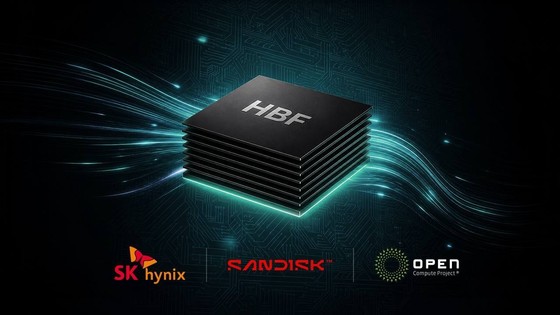
This specification is the first result of the collaboration that began last August for HBF standardization, released about six months after the consortium’s launch in February. It supports up to 512GB capacity and 3.0TB/s bandwidth, ensuring compatibility with various processors like graphic processing units (GPUs) and central processing units (CPUs) through the industry-standard UCIe interface.
The specification includes connection interfaces, electrical characteristics, packaging guidelines, and software usage instructions. It’s been presented as an open standard for industry-wide use, released through the Open Compute Project (OCP), the world’s largest open data center technology collaboration.
The HBF consortium currently includes SanDisk, Google, and AI chip company Tenstorrent, among others. SK Hynix plans to leverage this collaboration to accelerate the expansion of the AI storage ecosystem.
On the event’s opening day, SK Hynix’s Kim Cheon-seong, head of solution development, and Kang Wook-seong, in charge of next-generation product planning, will deliver a joint keynote on Efficient Implementation of AI Infrastructure Based on Tiered Memory in the Age of AI Agents.
They’ll discuss how the surge in data processing due to agentic AI proliferation presents challenges that a single memory product can’t address. They anticipate that Tiered Memory, connecting different memory types into a unified system, will become crucial for next-generation AI infrastructure.
The event’s final day will feature a panel discussion with representatives from Google DeepMind and SanDisk, exploring Overcoming the Memory Wall with HBF, focusing on AI memory architecture changes and HBF’s role.
At their exhibition booth, SK Hynix will unveil their 10th generation (V10) 375-layer 4D NAND, currently under development. This product boasts 2.5 times better performance per watt compared to previous generations. The company plans to start mass-producing high-performance, high-capacity eSSDs using this technology early next year.
Kim Cheon-seong stated that as AI use rapidly expands, it’s at a point where the entire data processing structure needs redesigning. Through HBF, it aims to push the boundaries between memory and storage, contributing to a new architecture that enhances overall system efficiency.