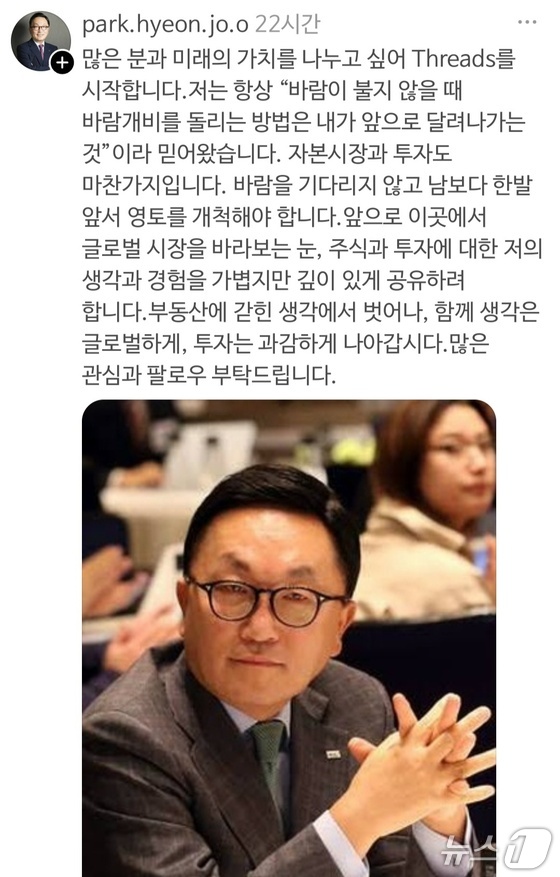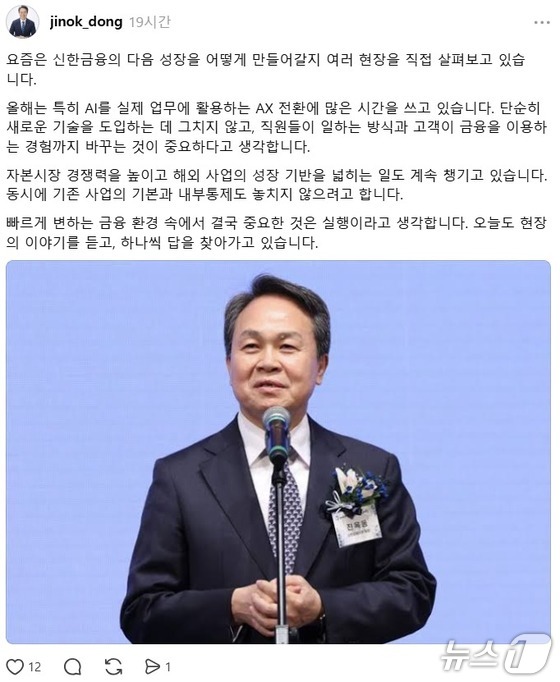
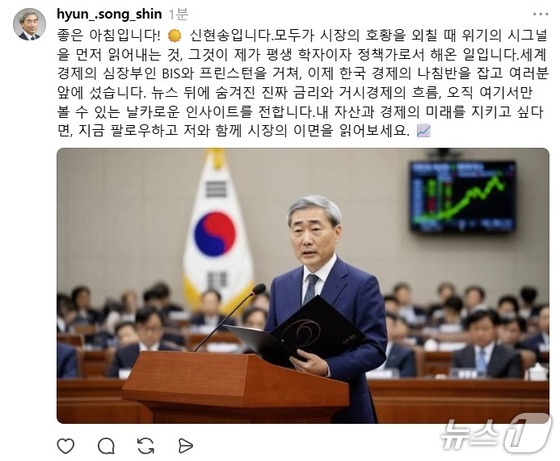
Social media accounts impersonating major figures in South Korea’s financial sector, including Shinhan Financial Group Chairman Jin Ok-dong, Mirae Asset Group Chairman Park Hyeon-joo and Bank of Korea Gov. Rhee Chang-yong, have appeared one after another. The accounts use not only the individuals’ real photos and career histories but also recent management issues to resemble official accounts, raising concerns that they could be exploited for investment scams and other financial crimes.
According to financial industry sources Sept. 23, an account impersonating Shinhan Financial Group Chairman Jin Ok-dong recently appeared on social media platforms including Threads. Shinhan Financial reported the account to the platform shortly after becoming aware of it and requested its removal.
The account’s profile description said, “Finance is not simply about moving money, but about connecting people and preparing for a better tomorrow,” adding, “I will continue to uphold trust and principles for a long time.”
The account also referred to Shinhan Financial’s recent management priorities, including its AX (AI transformation) strategy and efforts to strengthen its competitiveness in capital markets, making it appear to be operated by Jin himself. In one post, it said, “These days, I have been visiting various parts of the organization myself to see how we can create Shinhan Financial’s next phase of growth,” adding, “Today as well, I am listening to voices from the field and finding answers one by one.”
An account impersonating Bank of Korea Gov. Rhee Chang-yong has also appeared. The account introduced itself as “Bank of Korea Gov. Rhee Chang-yong” and cited his actual career history, including his professorship at Princeton University and his role as an economic adviser to the Bank for International Settlements (BIS). It also posted a message encouraging users to follow it, saying, “If you want to read the future of the economy together and stay grounded in uncertain times, follow me now!” The Bank of Korea said the account was not an official account.
An account impersonating Mirae Asset Group Chairman Park Hyeon-joo was also identified. The account said, “I started Threads because I want to share the value of the future with many people,” adding, “Let’s break free from thinking confined to real estate, think globally together and invest boldly. I ask for your interest and follows.”
There have also been cases in which impersonators exploited the issue of financial authorities relocating outside the capital region and went as far as requesting actual money transfers. Previously, an account called “fsdkorea,” which closely resembled the Financial Supervisory Service’s official account ID, “fsskorea,” impersonated Financial Supervisory Service Gov. Lee Chan-jin and asked users to send money through Kakao Pay, claiming it was collecting funds for the agency’s relocation outside the capital region.
The problem is that impersonation tactics are becoming increasingly sophisticated. Rather than simply stealing names and photos, the accounts use actual career histories, current issues and language resembling the individuals’ usual statements, making it increasingly difficult for users to distinguish them from official accounts.
The development of generative AI has also raised concerns that financial fraud could become more likely, as it allows posts mimicking the speech patterns and management philosophies of real people to be produced easily and in large quantities. The method typically involves initially posting economic and financial content to attract followers, then, once trust has been established, recommending investments in specific stocks or cryptocurrencies or directing users to separate investment groups or messaging services.
Within the financial industry, concerns are growing that repeated appearances of accounts impersonating prominent figures cannot be addressed through individual financial companies’ reports and removal requests alone. There are calls for social media platforms to strengthen systems that can quickly identify and block accounts impersonating prominent figures or employees of financial companies and prevent the repeated creation of impersonation accounts.