

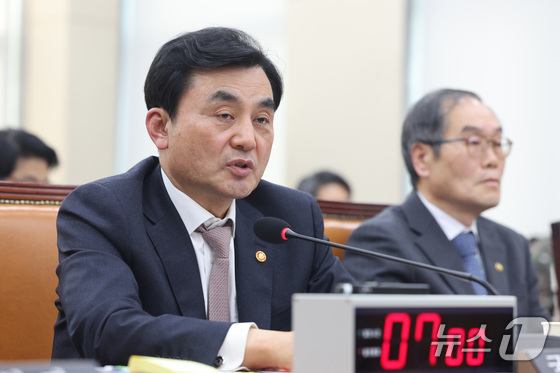
On Tuesday, Defense Minister Ahn Gyu-back clarified that the U.S. has not formally requested any troop deployments in response to President Donald Trump’s call for major allies to send forces to the Strait of Hormuz.
Minister Ahn made this statement during a National Defence Committee meeting at 3:00 p.m. (South Korean time), answering a query from Rep. Seong Il-jong, chair of the committee, who asked about potential deployment requests or ongoing considerations.
President Trump had used his social media platform, Truth Social, on March 14 to urge seven countries, including South Korea, to dispatch naval vessels and other military assets to the Strait of Hormuz.
Minister Ahn emphasized that it doesn’t consider social media messages as official requests. To date, they’ve received no formal communication from the U.S. on this matter.
Responding to Rep. Jung Cheong-rae’s question about potential future requests, Ahn stated that while they’re internally reviewing various scenarios, it wouldn’t be appropriate to disclose the preparations at this time.
When Rep. Jung expressed concerns about the risks of deploying to the Strait of Hormuz, Minister Ahn acknowledged the difference in operational scope compared to the Cheonghae Unit’s anti-piracy mission in the Gulf of Aden, noting that this would require extensive preparation. He refrained from commenting on the possibility of deploying the Cheonghae Unit.
Rep. Lim Jong-deuk inquired about the criteria for determining an official request. Ahn explained that there are established protocols, such as formal document exchanges or high-level discussions between defense ministers. None of these have occurred.
Addressing concerns about the Cheonghae Unit’s readiness, Ahn conceded that the current weaponry and capabilities would need significant upgrades for such a mission.
When Rep. Han Gi-ho asked about the need for National Assembly approval for a potential Hormuz deployment, Ahn confirmed tha under Article 60, Section 2 of the Constitution, such a deployment would require Assembly consent.