

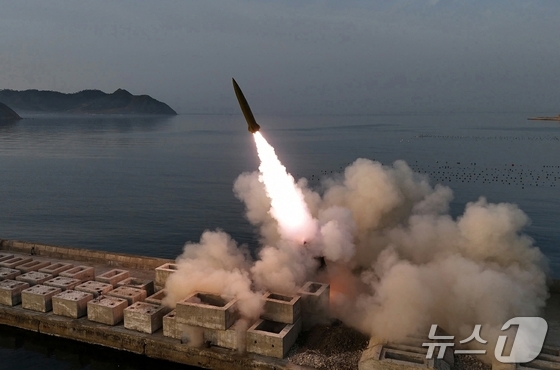
North Korea has announced the successful test launch of its new tactical ballistic missile, the Hwasong-11R. This missile appears to be highly lethal, particularly due to its ability to carry cluster munitions in its warhead. Analysts suggest that this puts major U.S. military installations in South Korea, including those near Seoul, within striking distance. This development indicates that North Korea is perfecting a system capable of hitting frontline targets at will during a potential conflict.
Beyond Seoul: Tactical Missile Capability Strengthened, Now Targeting U.S. Bases in Pyeongtaek and Osan
The regime’s official newspaper, Rodong Sinmun, reported on Monday that the Missile Bureau conducted a test launch on April 19 to evaluate the warhead’s effectiveness of the upgraded Hwasong-11R ground-to-ground tactical ballistic missile. Kim Jong Un and his daughter Ju Ae were present to observe the test.
The newspaper stated that the test aimed to confirm the characteristics and power of cluster munitions and fragmentary mine warheads used in tactical ballistic missiles. The Hwasong-11R is believed to be part of the KN-23 series, often referred to as North Korea’s version of the Iskander. It appears to be a compact model with reduced length and diameter compared to the existing KN-23 (Hwasong-11A).
From April 6 to 8, North Korea also tested the Hwasong-11A, another short-range ground-to-ground missile, equipped with cluster munitions.
Cluster munitions, containing dozens to hundreds of submunitions within a single warhead, spread upon detonation. These weapons are difficult to intercept mid-air and are highly lethal, earning them the moniker devil’s weapons.
North Korea claimed that five Hwasong-11R missiles struck a 12.5 to 13-hectare area on an island 136 kilometers (about 84.5 miles) away with high precision. This area is roughly equivalent to 18 soccer fields. Compared to the 6.5 to 7 hectares reportedly destroyed during the April 6-8 cluster munition tests, the destructive power has approximately doubled.
Hong Min, a senior researcher at the Korea Institute for National Unification, explained that the 136-kilometer (about 84.5 miles) range covers not only Seoul but also reaches U.S. military bases in Pyeongtaek, Osan Air Base, and areas like Songtan, Anjung, Cheonan, and Asan. This system bridges the gap between existing multiple rocket launchers and short-range ballistic missiles, enabling strikes on critical targets in the Seoul-Pyeongtaek corridor, a highly sensitive area for the U.S.-South Korea alliance.
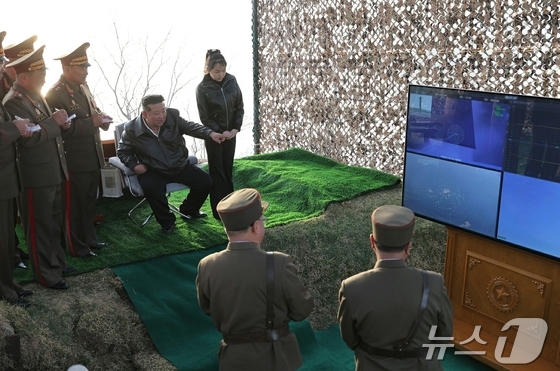
North Korea Bobilizes Frontline Corps Commanders to Missile Launch Site
Notably, several high-ranking officials attended the launch, including Kim Jong-sik, First Deputy Director of the Party Central Committee, Jang Chang-ha, Director of the Missile Bureau, and commanders of various army corps. Their unusual presence suggests that this weapon system is intended for deployment with frontline units, further indicating North Korea’s aim to strike key positions in the capital region and along the front lines using short-range ballistic missiles in a crisis scenario.
This development suggests that the weapon system is intended for frontline corps deployment, likely aimed at striking key positions in the capital region and along the front lines during a potential conflict using short-range ballistic missiles.
North Korea has previously claimed to have deployed 250 new tactical ballistic missile launchers to the frontlines, raising the possibility that these missiles are now operationally deployed.
On August 5, 2024, Rodong Sinmun reported a ceremony in Pyongyang on August 4 for the delivery of 250 new tactical ballistic missile launchers to frontline units of the Democratic People’s Republic of Korea (North Korea).
During the ceremony, General Secretary Kim declared that these formidable weapons systems lined up before them will now be delivered to the military and will be responsible for crucial military operations in the border regions of the Democratic People’s Republic of Korea.
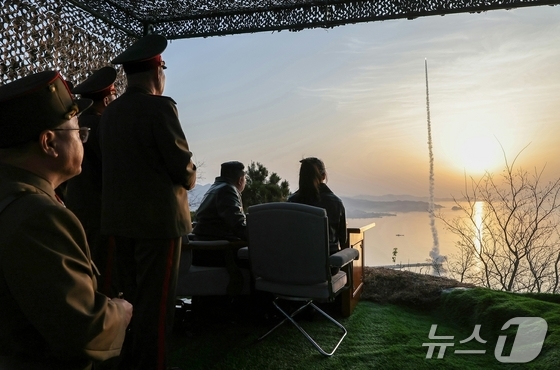
Tactical Shifts Likely Based on Russia Deployment Experience… Forward Forces Equipped With Both Nuclear and Conventional Capabilities
Experts emphasize the need to pay attention to North Korea’s recent efforts to bolster its frontline combat capabilities. According to Rodong Sinmun, General Secretary Kim recently observed special operations forces training and evaluated new tank interception systems in a single day.
This indicates North Korea’s intent to enhance its frontline strike capabilities and deterrence against South Korea by modernizing both nuclear and conventional weapon systems.
Furthermore, these measures may reflect North Korea’s tactical shift following its experience of deploying large combat units to Russia and participating in the Ukraine conflict. They likely recognized the necessity of securing key positions on the ground after striking core cities with a significant number of missiles.
Hong noted that in recent years, North Korea has been developing precision strike capabilities for short-range tactical guided missiles. They are clearly working towards establishing a frontline force structure that incorporates both nuclear and conventional capabilities.