

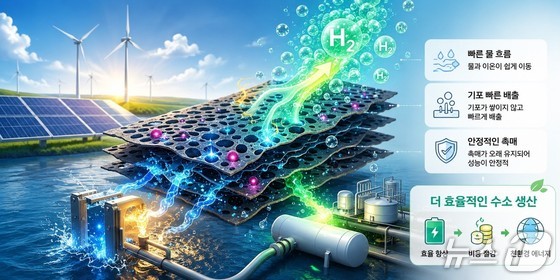
The Korea Advanced Institute of Science and Technology (KAIST) announced on Thursday that Professor Lee Jin-woo’s research team from the Department of Chemical and Biological Engineering, in collaboration with Dr. Kim Sung-jun’s team from the Korea Research Institute of Chemical Technology and Professor Jang Yong Lee’s team from Konkuk University, has developed a design technology that simultaneously enhances the performance and stability of Anion Exchange Membrane Water Electrolysis (AEMWE).
AEMWE is gaining attention as a next-generation eco-friendly hydrogen production technology due to its low precious metal usage and high cost-effectiveness. However, bubble formation inside the catalyst layer in high-current operating environments poses challenges by blocking mass transfer and reducing reaction efficiency. Moreover, long-term operation can lead to catalyst agglomeration and interfacial degradation, making it crucial to develop a system that achieves both high efficiency and durability.
The research team created a low-curvature structure using paper-thin two-dimensional mesoporous carbon nanosheets, allowing materials to move freely without obstruction. This structure acts as a highway-like passage for water and gas to pass through quickly, replacing the narrow and complex pathways within the catalyst layer.
By anchoring ruthenium (Ru) nanoclusters onto the defect-introduced carbon surface, they boosted the hydrogen generation reaction rate and engineered the interfacial structure to prevent catalyst damage during extended operation.
Applying this technology, they demonstrated stable operation for 1,000 hours at efficiencies surpassing the U.S. Department of Energy (DOE) targets in a high-temperature environment of about 176 degrees fahrenheit, using minimal amounts of precious metals.

The research team emphasized that this breakthrough is significant as it paves the way for more cost-effective and efficient production of eco-friendly hydrogen.
This technology is expected to have wide-ranging applications, including large-scale green hydrogen production, eco-friendly power generation systems, hydrogen vehicles, sustainable mobility, and carbon-neutral industrial processes.
Professor Lee explained that this research enhances electrolytic efficiency by designing not only the catalyst itself but also the pathways for energy flow. It expects it to accelerate the commercialization of eco-friendly hydrogen production, as it enables high-efficiency green hydrogen generation with minimal use of precious metals.
KAIST doctoral students Byeon Jae-ho and Ban Min-kyeong participated as co-first authors, and the research findings were published online in the prestigious energy journal Joule. The study is scheduled to appear in the September issue of Joule.
The research was supported by the National Research Foundation of Korea’s AEM Water Electrolysis Technology Development program, the Nano Future Material Source Technology Development initiative, the Ministry of Education’s Doctoral Students Research Grant Program, the Korea Research Institute of Chemical Technology, and LOTTE CHEMICAL CORPORATION’s Carbon Neutral Center.