

On June 19, North Korea and Russia marked the second anniversary of their Comprehensive Strategic Partnership Treaty (the North Korea-Russia New Treaty). During this period, North Korea has deployed substantial combat forces to Russia. In return, Russia has generously provided economic and military benefits to North Korea. This has led analysts to conclude that the relationship between the two nations has escalated to a blood alliance level.
The North Korea-Russia New Treaty was signed on June 19, 2024, during a summit in Pyongyang between Kim Jong Un and President Vladimir Putin. At the time, Putin described the treaty as a document that would form the foundation of North Korea-Russia relations for years to come. Kim declared that the two countries had reached a new, elevated level of alliance.
Notably, Article 4 of the treaty includes provisions for automatic military intervention in case of emergencies. It states that if either party faces a military invasion from one or multiple countries and enters a state of war, the other party shall provide immediate military and other assistance, in accordance with Article 51 of the United Nations (UN) Charter and the laws of both nations.
Following this, North Korea has deployed approximately 20,000 troops, including combat and engineering units, to the conflict zone in the Kursk region of Russia and Ukraine in four separate deployments since October 2024. According to NK News, a U.S.-based North Korea-focused media outlet, as of early this year, around 14,000 North Korean soldiers remain stationed in Russia, with cumulative casualties estimated at about 7,000.
On April 27, a memorial facility for fallen North Korean soldiers was completed in Pyongyang to commemorate the first anniversary of the Liberation of Kursk operation. A Russian delegation, led by Vyacheslav Volodin, the Speaker of the State Duma, attended the inauguration. Kim emphasized that this memorial has inscribed a new history of friendship between North Korea and Russia written in blood, underscoring the blood alliance between the two nations.
This event commemorated Russia’s official declaration on April 26 of last year regarding the recapture of Kursk, which Russia had temporarily lost during the war with Ukraine. The deployment of North Korean troops is believed to have played a significant role in Russia’s recovery of Kursk.
North Korea is currently constructing Saeppyol Street in the Daesung District of Pyongyang, where families of the deployed soldiers can live together. This project aims to create a large memorial space in the heart of the capital, including the remains of fallen soldiers and commemorative monuments. This move is seen as an attempt to reinforce to the North Korean people that Russia is now an inseparable ally.
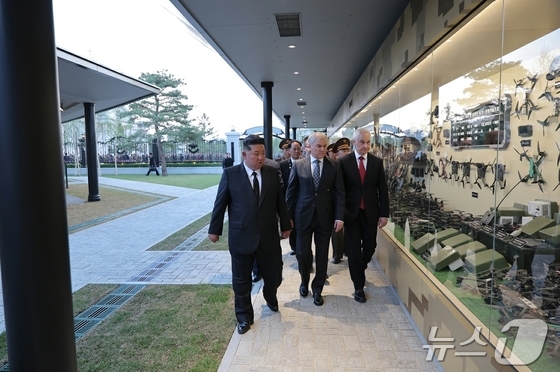
Since signing the treaty, the two countries have strengthened their cooperation across military, political, social, and economic spheres. High-level communications have increased significantly.
In August of last year, Speaker Volodin visited Pyongyang to attend events celebrating the 80th anniversary of Liberation Day. Two months later, in October, Dmitry Medvedev, Deputy Chairman of the Russian Security Council and a close aide to President Putin, visited North Korea to attend the 80th anniversary of the founding of the Workers’ Party of Korea. North Korean Foreign Minister Choe Son-hui visited Moscow last October to meet with President Putin and other officials.
Kim and Putin also held a bilateral meeting in Beijing last September during China’s 80th Victory Day parade. The two leaders have been meeting annually since 2023, leading to speculation that Kim will visit Russia again this year.
However, some analysts suggest that the two countries, having rapidly grown closer due to the Ukraine war, might drift apart once the conflict ends. Additionally, the issue of compensation for troop deployments remains a significant variable in their relationship.
Dongguk University Emeritus Professor Ko Yu-hwan noted that since North Korea made the unprecedented decision to assist Russia when it faced difficulties in the war, North Korea is likely demanding various forms of support, including energy and food, from Russia behind the scenes.
He added that regardless, the shared bloodshed is an undeniable communal history. More importantly, both North Korea and Russia face strong sanctions from the West and share a diplomatic goal of multipolarity, making it unlikely that their current cooperation will easily collapse.