

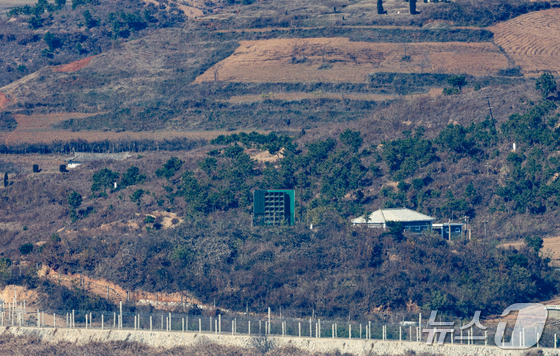
The U.S. military has condemned North Korea’s installation of barbed wire near the Military Demarcation Line (MDL) as a clear violation of the armistice agreement. This move is part of Pyongyang’s efforts to fortify its border.
In a statement released on Monday, the Joint Chiefs of Staff declared that the North Korean military’s placement of obstacles near the MDL is an outright breach of the armistice agreement. The forces will continue to respond in close coordination with the United Nations Command.
The Joint Chiefs further noted that the military is maintaining vigilant surveillance of North Korean activities around the MDL. It’s effectively managing the military situation while upholding a robust state of readiness.
Intelligence sources, including information from Rep. Kang Dae-sik of the People Power Party, reveal that North Korean forces have erected barbed wire as close as 100 meters (about 0.062 miles) north of the MDL. This marks the first confirmed instance of such proximity to the boundary.
Following its declaration of North-South relations as hostile states in late 2023, North Korea initiated border fortification efforts north of the MDL in April 2024. These include land clearing, tactical road construction, and the installation of barbed wire and mines. Reports indicate that Pyongyang has largely completed land clearing operations near the MDL, with approximately 60-70 km (about 37.3 to 43.5 miles) of tactical roads and 80-90 km (about 49.7 to 55.9 miles) of barbed wire now in place.
The 1953 armistice agreement, signed by the United Nations (UN) Command, North Korea, and China, prohibits all hostile actions within the 2 km-wide (about 1.24 miles wide) Demilitarized Zone (DMZ) straddling the MDL. North Korea’s recent activities near the MDL potentially contravene the spirit of this agreement.
The UN Command, however, has adopted a more measured stance than the South Korean government. They stated that DMZ activities must be evaluated within their broader context, considering relevant provisions of the armistice agreement and subsequent accords, as well as specific circumstances. Not all construction, fortification, or defensive measures automatically constitute violations of the armistice.
The UN Command added that if necessary, it will address armistice-related concerns through established channels, maintaining the commitment to peace and stability on the Korean Peninsula.