

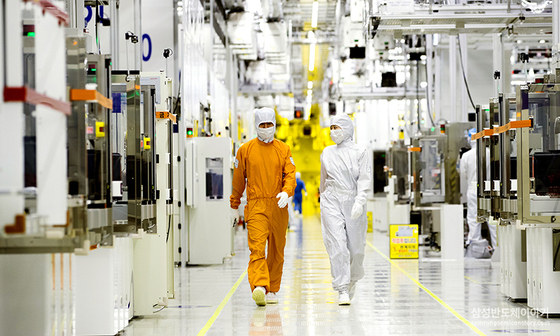
Samsung Electronics’ HBM4 sales have reportedly crossed the 1 billion USD mark, a first for the industry. This milestone comes just over 130 days after the company began mass production of HBM4 on February 19.
Industry sources revealed on Tuesday that Samsung’s HBM4 sales have surpassed 1 billion USD. Projections indicate sales could reach 1.2 billion USD by the end of June and potentially exceed 10 billion USD by year-end.
The rapid increase in supply following the HBM4 launch suggests Samsung’s market share in the high-bandwith memory (HBM) sector will expand quickly.
AI Memory Supercycle: ASIC Customer Expansion Driving Growth
The success of HBM4 is largely attributed to the surge in demand driven by increased investments in artificial intelligence (AI) infrastructure.
Global investment banks project the HBM market to grow by 58% year-over-year in 2026, reaching 54.6 billion USD. The World Semiconductor Trade Statistics (WSTS) anticipates the global semiconductor market will approach 1 trillion USD this year.
A key driver of this demand is application-specific integrated circuits (ASICs). These custom-designed chips are rapidly boosting HBM demand as tech giants adopt them for their AI chips.
Samsung continues to receive requests for HBM supply collaborations from major graphic processing unit (GPU) manufacturers and ASIC-based hyperscaler clients. With its expanding customer base, Samsung’s HBM sales are expected to triple in 2026 compared to 2025.
Hyperscalers are large tech companies operating massive data centers with hundreds of thousands of servers and extensive network infrastructures, providing cloud computing and AI services globally.
Kim Dong-won, an analyst at KB Securities, predicts a significant increase in Samsung’s HBM shipments by 2027, citing the company’s diverse customer base including Broadcom, Google, Amazon, Microsoft, and Meta.
Kiwoom Securities also identifies the expansion of the ASIC market as a key growth driver for Samsung’s HBM business. Analyst Park Yoo-ak anticipates Samsung’s HBM shipments could increase by over 200% year-over-year in 2026, driven by rapidly growing ASIC demand in the AI market.
Industry’s First HBM4 Mass Production: Elevating Speed and Power Efficiency
Samsung has secured a competitive edge by boldly applying a 4nm advanced process to the base die of HBM4 memory, enhancing both performance and production stability.
In February, Samsung became the first in the world to mass-produce HBM4, taking the lead in the next-generation AI memory market.
HBM is the core memory enabling AI semiconductors to quickly exchange vast amounts of data. Samsung’s HBM4 boasts a data processing speed about 46% faster than industry standards (11.7 Gbps), effectively addressing the data bottleneck that intensifies with larger AI models.
The amount of data processed simultaneously has also increased significantly, with data transfer capabilities approximately 2.7 times higher than previous models, exceeding customer performance requirements.
While enhancing performance, Samsung improved power efficiency by about 40% compared to the previous generation. This reduction in power consumption and cooling costs offers significant benefits for data centers, allowing them to achieve both performance and operational cost efficiency.
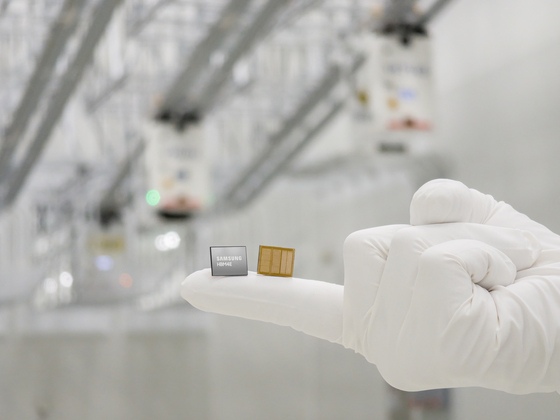
One-Stop Capability in Memory, Foundry, and Packaging: Expanding Leadership with Next-Gen Lineup
Samsung plans to leverage its technological advantages in the next-generation HBM4E to maintain market leadership.
As a comprehensive semiconductor company integrating logic, memory, foundry, and packaging, Samsung possesses one-stop capabilities from design through packaging.
The synergy among these three sectors allows Samsung to respond flexibly to customer demands, setting it apart from competitors.
As HBM technologies evolve, the logic proportion of the base die will increase in HBM4E and HBM5. Samsung’s ability to optimize its proprietary foundry processes alongside HBM design is expected to be a significant competitive advantage.
Industry experts believe that starting with HBM4E and HBM5, design capabilities for logic base die and process competitiveness will become even more critical than simple DRAM stacking technologies. Companies with both cutting-edge process and packaging capabilities are likely to gain a competitive edge.
The logic base die is the core layer of HBM, formed by vertically stacking multiple dynamic random access memory (DRAM) chips. It plays a crucial role in data control, computational assistance, and power management for AI semiconductors.
An industry insider noted that since HBM4 and HBM4E products are expected to become mainstream by 2030, Samsung is anticipated to take the lead in future HBM competition.