


The departure tax, which had remained unchanged for 27 years, has been reduced, exposing the precarious state of the Tourism Promotion Development Fund, the sole financial resource for the tourism industry. While other countries are increasing their tourism funding, South Korea is moving in the opposite direction, intensifying challenges in the tourism sector.
On Monday afternoon, industry leaders, including officials from the Ministry of Culture, Sports and Tourism and tourism-related organizations, convened at the National Assembly in Yeouido, Seoul. The discussion, titled, Why Now for the Realignment of the Departure Tax?, emphasized the urgent need to expand funding sources.
Currently, Democratic Party lawmaker Jo Gye-won has proposed a bill to increase the departure tax by 20,000 KRW (about 13 USD), amending the Tourism Promotion Development Fund Act.
South Korean travelers pay a departure tax of 8,000 KRW (about 5.21 USD) included in their airfare—7,000 KRW (about 4.56 USD) for the Tourism Promotion Development Fund and 1,000 KRW (about 0.65 USD) for the Disease Eradication Fund. This represents a reduction from the previous 11,000 KRW (about 7.17 USD), implemented in July 2024 by the Yoon Suk Yeol administration to alleviate citizens’ financial burden.

Global Tourism Funding Increases While South Korea Lags Behind
Major players in the global tourism market are aggressively boosting their tourism funding. Japan will triple its international tourism passenger tax from 1,000 JPY (about 6.19 USD) to 3,000 JPY (about 18.56 USD) starting July 1, allocating the additional funds to enhance immigration procedures, improve tourism infrastructure, and address overtourism.
Thailand has also raised its departure tax by about 50% to 54,000 KRW (approximately 35.19 USD) as of June 20. Australia has steadily increased its departure tax from 10 AUD (about 6.96 USD) in 1978 to 80 AUD (about 55.72 USD) today, while the UK has raised its tax from 10 GBP (about 13.23 USD) for long-haul flights to 216 GBP (about 285.87 USD).
Lawmaker Jo criticized the Yoon government’s decision to reduce the departure tax, calling it a shadow tax. He pointed out that this move has only deepened the fund’s debt. The Organisation for Economic Co-operation and Development (OECD) average departure tax is 29,000 KRW (about 18.9 USD), while South Korea’s is just 7,000 KRW (about 4.56 USD). This discrepancy means each traveler is losing out on 22,000 KRW (about 14.33 USD) in potential funding.
Tourism Policies Hampered by Fund Depletion
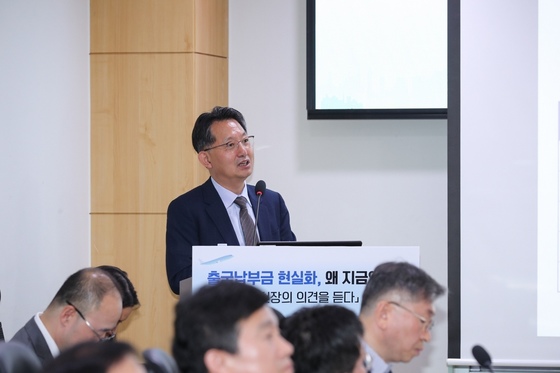
Dr. Ryu Kwang-hoon from the Korea Culture and Tourism Institute presented concerning financial figures regarding the tourism fund.
The Ministry of Culture, Sports and Tourism has allocated a mere 2 billion KRW (1.3 million USD) for tourism in its general account for 2026. In effect, the tourism promotion development fund, amounting to about 1.2 trillion KRW (about 781.79 million USD), is the only financial resource for policies. The problem is exacerbated by the shrinking fund due to the reduced departure tax. The collection amount for 2025 is projected at 262.4 billion KRW (about 170.95 million USD), a decrease of over 135 billion KRW (about 87.95 million USD) compared to 2019 (about 400 billion KRW or about 260.65 million USD).
Dr. Ryu emphasized that considering the local government subsidy rate of 50%, this effectively means a tourism policy budget of 300 billion KRW (about 195.48 million USD) has evaporated.
The debt situation is also alarming. Due to sharp revenue drops during the COVID-19 pandemic, the fund borrowed 2.4 trillion KRW (1.56 billion USD) from the Public Fund Management Fund, incurring an annual interest burden of 50 billion KRW (32.58 million USD). Dr. Ryu criticized South Korea as the only country to reduce a fixed amount by 30% after 27 years since its 1997 introduction, despite the quadrupling of nominal gross domestic product (GDP).

Transparency and Structural Improvements Crucial for Public Trust
While there’s consensus on the need for an increase, some voices highlighted the fund’s structural issues.
Jo Kwang-ik, senior vice president of the Korean Tourism Association, pointed out a fundamental mismatch: travelers pay the departure tax, but tourism businesses reap the benefits. This discrepancy undermines the fund’s legitimacy. Approximately 650 billion KRW (about 423.43 million USD) of the 1.2 trillion KRW (about 781.79 million USD) tourism promotion development fund is allocated to loans for tourism businesses.
Jo suggested alternative approaches, such as supporting the fund through vouchers or local currency, allowing citizens to spend locally and indirectly benefit tourism businesses. He advocated for a comprehensive discussion on various funding methods, including expanded government contributions, increased casino taxes, and the introduction of accommodation taxes.
Lee Kyung-soo, president of the Korea Tourism Association, outlined three key investment areas for the secured funds: local tourism innovation, enhanced travel safety for citizens, and improved tourism infrastructure. He stressed the importance of public transparency in fund allocation.
Yoo Yong-jong, president of the Korea Hotel Association, noted that most citizens are unaware of the departure tax. He revealed that this year’s tourism fund has already been depleted, leaving local hotels without loan support. Hwang Jun-seok, executive vice president of the Korea Travel Agency Association, emphasized that ensuring transparency in fund usage is crucial for increasing public acceptance of any tax increase.
Tourism Fund: A Vital Investment For 30 Million Visitor Era
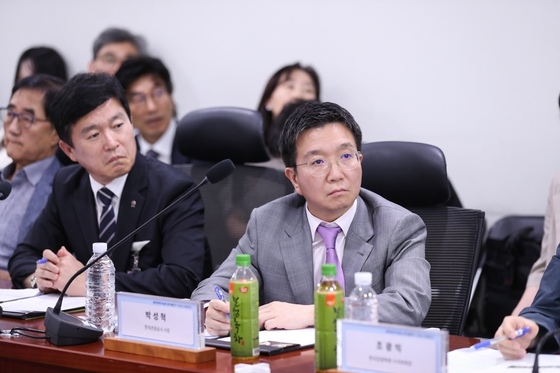
Park Sung-hyuk, president of the Korea Tourism Organization, presented concrete achievements from the fund.
From January to April this year, South Korea welcomed 6.77 million foreign visitors (a 21.4% year-on-year increase), with foreign consumer spending reaching approximately 8 trillion KRW (about 5.21 billion USD, up 47.3%). Regional airports saw a 45.3% increase in arrivals, alongside a 42.7% surge in foreign regional spending.
Park emphasized that the tourism fund has been instrumental in these achievements, including the distribution of 1.52 million coupons for the accommodation sale festival and generating a ninefold economic ripple effect compared to the worker vacation support program. He stressed that securing stable funding is crucial to achieve the goal of attracting 30 million foreign tourists by 2028.
Kang Dong-jin, tourism policy director at the Ministry of Culture, Sports and Tourism, noted the tourism industry’s vulnerability to external shocks and the inverse relationship between crises and funding. He emphasized that realigning the departure tax to enhance the tourism fund is essential for reaching the 30 million foreign tourist goal early. Kang pledged to focus all efforts on revising the relevant legislation.