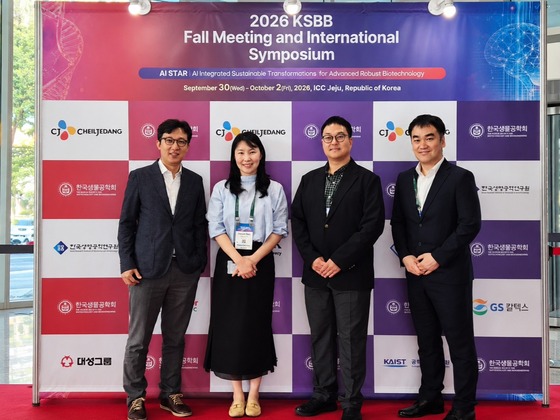
GC Biopharma announced on Friday that it presented key research findings of its proprietary mRNA-LNP platform at the 2nd Gene and Cell Therapy Summit (GCT 2026) in Austria and the 2026 Korean Society for Biotechnology and Bioengineering’s fall conference and international symposium.
The presentations focused on Strategic Design of a Multipurpose mRNA-LNP Platform for Targeted Chronic Disease Treatment and Precision Delivery and GC Biopharma’s Integrated mRNA-LNP and Manufacturing Platform for Next-Generation Therapeutics, showcasing the company’s capabilities from mRNA-LNP design to production.
mRNA is genetic material that instructs cells to produce specific proteins. Untranslated regions (UTRs), which regulate protein expression levels and duration, and polyA structures, which enhance mRNA stability, play crucial roles in mRNA performance.
The company applied AI-based codon optimization to its proprietary UTR sequences and polyA structures, boosting protein translation efficiency by over 50% compared to benchmarks. GC Biopharma currently holds eight patents related to mRNA components, reinforcing its competitive edge in mRNA design.
In the LNP field, GC Biopharma has also achieved notable breakthroughs. Its proprietary LNP maintained stable protein expression without antibody formation against PEG after repeated intravenous administration in primate models, indicating potential for chronic disease applications requiring repeated dosing.
Using structure-activity relationship (SAR) modeling, the company developed a unique lipid library, leading to LNP candidates capable of selectively targeting specific organs and cells. Animal studies demonstrated superior delivery efficiency compared to benchmark LNPs in various tissues and cells, including lungs, spleen, brain, immune cells, and cancer cells.
The company’s proprietary LNP also showed promise in cancer vaccine research. Studies revealed a stronger antigen-specific CD8+ T-cell response compared to benchmarks, with significant tumor size reduction observed in animal models.
Building on these achievements, GC Biopharma plans to expand its mRNA-LNP platform applications to rare genetic disorders, chronic inflammatory conditions, cancer immunotherapies, and vaccines.
The company has established manufacturing infrastructure to bridge research outcomes with drug development. GC Biopharma’s Hwasun plant boasts General MotorsP-level production capabilities for mRNA-LNP, enabling seamless transition from research to commercial manufacturing.
The proprietary mRNA-LNP platform is currently undergoing clinical validation. The COVID-19 mRNA vaccine candidate GC4006A, which utilizes this platform, has entered Phase 2 trials as part of a government-sponsored project. GC Biopharma aims to validate the platform’s efficacy and versatility through clinical development while expanding its pipeline across various therapeutic areas.
Jae-wook Jung, GC Biopharma’s Research and Development (R&D) chief, stated that its mRNA-LNP platform represents years of dedicated research and development. They’re validating it through COVID-19 vaccine trials and plan to leverage this technology across diverse therapeutic areas in the future.