

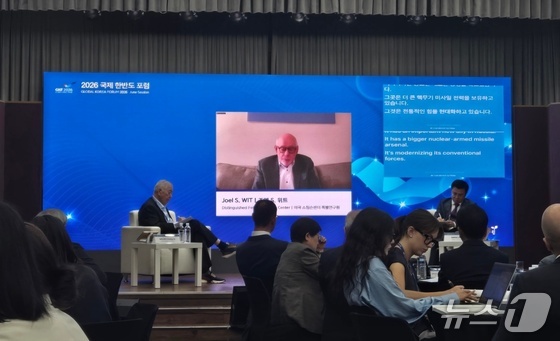
Joel Wit, a former U.S. State Department official who participated in the 1994 U.S.-North Korea Agreed Framework negotiations, expressed deep pessimism about the prospects for renewed engagement with North Korea, arguing that Pyongyang has fundamentally changed and is no longer interested in rebuilding relations with either the United States or South Korea.
Speaking via video link at the 2026 International Korean Peninsula Forum held in Seoul on Sunday, Wit said North Korea today is vastly different from the country that participated in the last denuclearization negotiations in 2019.
“North Korea has very little interest in reengaging with the United States or South Korea,” said Wit, now a distinguished fellow at the Stimson Center and co-founder of North Korea-focused analysis platform 38 North.
“The 30 years during which I believed North Korea could change are over,” he said. “If we want to realistically improve relations with North Korea, we must understand not only history but also how different today’s North Korea is from the past.”
Wit cautioned against quickly arranging another summit between U.S. President Donald Trump and North Korean leader Kim Jong Un.
“I think that would be very risky,” he said. “There is a high likelihood that Kim would agree to things we do not want, and there is also a strong possibility that North Korea would try to push a new agenda in its relations with South Korea, the United States and the international community.”
Responding to questions about whether his assessment was overly pessimistic, Wit said his position reflected reality rather than pessimism.
“This is not pessimism. It is a realistic assessment of the situation,” he said. “We need to examine the circumstances very carefully.”
Asked whether peaceful coexistence with a nuclear-armed North Korea is possible, Wit said there may theoretically be areas of common interest involving North Korea and potentially China and Russia, but added that such areas are currently very limited.
Wit noted that he had supported engagement with North Korea for three decades and had written extensively on U.S. policy toward Pyongyang. However, he stressed that the current environment differs dramatically from previous periods of diplomacy.
He also questioned the practicality of denuclearization initiatives that envision a phased process of freezing, reducing and eventually dismantling North Korea’s nuclear capabilities.
“There’s nothing particularly new about that approach,” Wit said. “As long as the goal of denuclearization remains unchanged, it may be the best possible framework. But I do not believe that approach will work under today’s conditions.”
He further argued that formally recognizing North Korea as a nuclear-armed state would not necessarily make renewed negotiations easier.
“I do not think dialogue would automatically become more active,” he said. “North Korea will not approach negotiations while maintaining the same objectives it pursued during previous periods of engagement.”
As a more realistic near-term measure, Wit pointed to the 1973 U.S.-Soviet Agreement on the Prevention of Nuclear War as a potential model.
He proposed a new declaration affirming that nuclear war must be avoided, whether intentional or accidental, and reiterating that a nuclear war cannot be won and must never be fought.
While acknowledging that such a declaration would largely be symbolic, Wit suggested it could serve as a practical starting point for reducing tensions.
He added that if the United States, Russia, China and South Korea were to participate in such an initiative, North Korea might also be willing to endorse it.
Wit’s remarks highlight growing skepticism among some longtime North Korea experts about the viability of traditional engagement strategies as Pyongyang continues to expand its nuclear capabilities and deepen its alignment with Russia while maintaining a confrontational stance toward Washington and Seoul.