

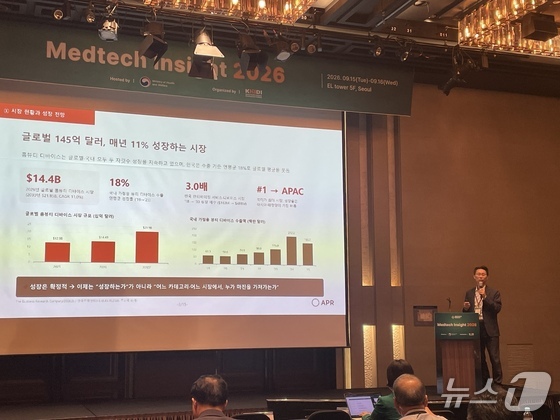
The era of beauty devices solely relying on superior hardware is over.
Now, the most crucial challenge is how to effectively leverage data using artificial intelligence (AI).
Shin Jae-woo, Executive Director of APR, made this statement on Tuesday at the Medtech Insight 2026 conference held at the L Tower in Yangjae, Seoul.
The event, organized by the Korea Health Industry Development Institute, featured extensive discussions on various medical device companies’ strategies for global expansion and their applications in healthcare settings.
Shin observed that while the home beauty market previously focused on devices performing individual functions like cleansing or skincare, it is now shifting towards providing consumers with a holistic experience by integrating cosmetics, apps, and AI.
To achieve this, APR is currently implementing AI technology that analyzes device usage patterns and consumer responses to recommend appropriate care methods for subsequent use.
Shin explained that it’s not just about selling a device; it’s crucial to create an ecosystem that connects devices with cosmetic recommendations, fostering repeat purchases.
Wontech, a medical device company, also projected the need to expand its business into the business-to-consumer (B2C) market, where general consumers can directly purchase products, moving beyond hospital equipment.
Seo Young-seok, Chief Technology Officer (CTO) of Wontech, remarked that the business-to-business (B2B) market has inherent limitations. Hospitals are finite, and after selling one unit, it takes considerable time before a repurchase. In contrast, the home beauty market allows for creating a new recurring revenue model by combining devices, cosmetics, and apps.
However, he emphasized that simply manufacturing quality products is insufficient for international markets. Each country has unique regulations, consumer skin concerns, and purchasing behaviors, necessitating localization strategies.
Seo cautioned that it’s a grave error to assume that consumers in China and Japan have identical beauty perceptions or skin concerns just because of geographical proximity. Companies must meticulously prepare for country-specific certifications, local languages, and cultural nuances.
Similar issues were raised during the session on Strategies for Entering the Medical AI Field.
Despite the rapid advancement in technology development and approval for AI medical devices, their actual implementation in hospitals hinges on effectively managing user experiences and on-site data post-approval.
Kim Chi-won, Deputy Director of Kakao Ventures, stated that it needs to build robust clinical evidence demonstrating how medical AI can benefit patients and medical staff during actual treatment processes. This will pave the way for establishing insurance coverage and payment systems.
The government concurred that the post-approval phase is crucial for enhancing the global competitiveness of domestic AI medical devices.
Kim Yoo-ra, a director at the Ministry of Health and Welfare, noted that while the number of AI medical devices approved by the Ministry of Food and Drug Safety has surged to 473 as of 2025, many approved products have yet to be implemented in medical institutions or complete the insurance process.
She added that for AI medical devices to gain reliable adoption in clinical settings, it needs opportunities to verify not only their technical performance but also their clinical value and real-world applicability.
The institute plans to expand its support for empirical research, enabling medical institutions to directly use AI medical devices and gather data to bridge this gap.
Jeong Young-hoon, Planning Director of the Korea Health Industry Development Institute, stated that over the past five years, they’ve supported verifying the clinical efficacy and on-site applicability of products through digital healthcare empirical support. Starting this year, it’s also promoting a project for rapid commercialization of AI application products where multiple medical institutions collaborate to apply products and gather data.
He continued that next year, it plans to expand the number of participating medical institutions in empirical research and strengthen the synergy between hospitals and companies based on product characteristics. It will consistently support the process of building clinical evidence to ensure that medical AI can be effectively utilized in real healthcare settings.