

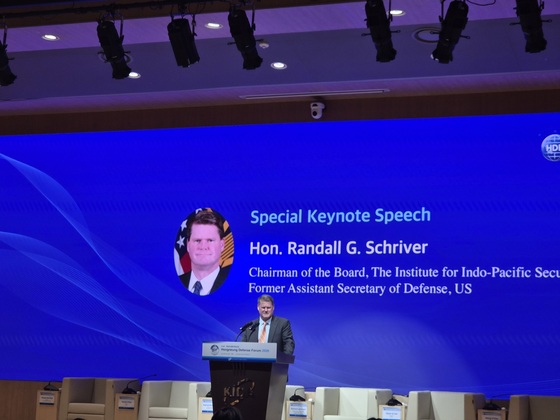
As U.S. strategic focus shifts to the Middle East and Ukraine, maintaining deterrence in the Indo-Pacific region has become increasingly challenging. In this context, a former top Pentagon official emphasized the growing importance of allies like South Korea, as well as the critical role of maintenance, repair, and operations (MRO), nuclear submarines, and technological cooperation.
Randall Schriver, former Assistant Secretary of Defense for Indo-Pacific Security Affairs, delivered these insights during a keynote address at the Hongneung Defense Forum 2026, hosted by the Korea Institute for Defense Analysis (KIDA) in Seoul on Tuesday.
Schriver noted that in Washington, the most valuable commodity isn’t money or military hardware—it’s the attention and time of the leadership. Currently, much of that focus is on Iran and the ongoing conflict in Ukraine.
He explained that as the U.S. juggles multiple regional crises, the risks of miscalculation or conflict in the Indo-Pacific are rising, along with the strain on ammunition supplies and logistical support. Schriver warned of the potential for adversaries to exploit this situation through opportunistic aggression.
The former Assistant Secretary also highlighted the strategic implications of growing ties between China, North Korea, Russia, and Iran. While Beijing may downplay these relationships as informal or limited, even modest cooperation among these actors could have far-reaching consequences, Schriver cautioned.
In the event of a crisis in the Taiwan Strait, Schriver assessed that North Korea and Russia might support China, potentially destabilizing the security situation on the Korean Peninsula.
On a positive note, Schriver praised the strength of the U.S.-South Korea alliance, particularly commending collaboration in shipbuilding and MRO. It’s making significant strides in nuclear submarine cooperation and expect breakthrough results in the joint technological initiatives, he added.
Schriver noted a marked improvement in South Korea’s standing within the Donald Trump administration. Early in Trump’s first term, there were grumblings about South Korea not pulling its weight. Now, President Trump, Defense Secretary Pete Hegseth, and Deputy Assistant Secretary of Defense Elbridge Colby all view South Korea as a model ally, he reported.
As U.S.-China Tensions Escalate, South Korea’s Strategic Value Increases
Schriver’s comments on the interconnected nature of potential crises in the Taiwan Strait and on the Korean Peninsula, along with South Korea’s evolving role, align with ongoing discussions about expanding the U.S.-Republic of Korea (ROK) alliance beyond peninsula defense to broader Indo-Pacific security.
The concept of strategic flexibility allows U.S. forces stationed abroad to be redeployed as needed, rather than being tied to specific regions or missions. For U.S. forces in South Korea, this could mean shifting from a peninsula-focused posture to a wider regional role.
Michael O’Hanlon, a senior fellow at the Brookings Institution, echoed these sentiments at the forum, stating that as U.S.-China competition intensifies, South Korea’s strategic importance will only grow. However, he cautioned that this might require Seoul to shoulder a greater share of its own defense burden.
From Beijing’s perspective, the expanding scope of the U.S.-ROK alliance is cause for concern. Zhao Minghao, a professor at Fudan University’s Center for American Studies, argued that the strategic flexibility of U.S. forces in Korea, Seoul’s pursuit of nuclear submarines, and strengthened U.S.-ROK-Japan trilateral cooperation are fundamentally reshaping the security landscape and complicating China’s regional calculus.
Zhao interpreted President Trump’s support for South Korea’s nuclear submarine program as a move to further integrate Seoul into a U.S.-led security architecture. He suggested that the emphasis on strategic flexibility for U.S. forces in Korea is aimed at countering not just North Korea, but also China and Russia.
Analyzing U.S. Forces Korea Commander Gen. Xaiver Brunson’s vision for a networked alliance system linking South Korea, Japan, and the Philippines, Zhao concluded that this strategy aims to leverage South Korea’s strategic depth against Chinese and Russian forces, secure critical maritime chokepoints through Japan, and enhance access to vital sea lanes connecting the Pacific and Indian Oceans via the Philippines.