

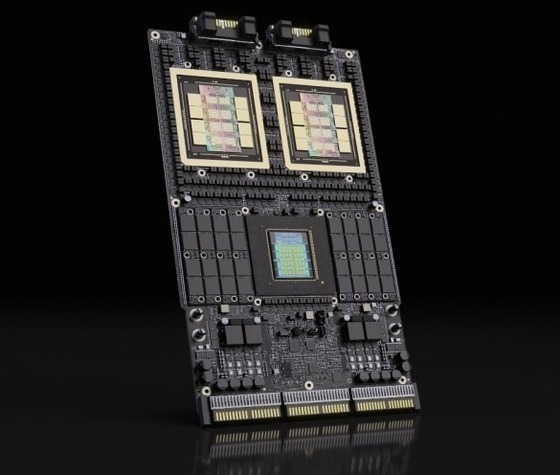
NVIDIA’s official launch of mass production and operations for its next-generation artificial intelligence (AI) platform, Vera Rubin, has signaled a positive outlook for the high-bandwidth memory (HBM) businesses of Samsung Electronics and SK Hynix. Vera Rubin not only significantly enhances AI accelerator performance but also increases memory capacity compared to previous generations, which is expected to drive demand for next-gen HBM4 and server memory.
On Wednesday, NVIDIA announced during its Q2 fiscal year 2027 earnings report that the Vera Rubin platform has entered full-scale production. The company also projected third-quarter revenue guidance at 108 billion USD, reaffirming ongoing investments in AI data centers.
Samsung, SK Hynix Ramp Up HBM4 Production; Set to Boost Second-Half Earnings
The full-scale production of Vera Rubin is poised to mark a new turning point for expanding demand for memory, including HBM. As AI accelerator performance improves, the integration of HBM and high-performance memory, such as server dynamic random access memory (DRAM), into systems will also increase.
Leading semiconductor giants Samsung Electronics and SK Hynix have already entered the race for HBM4 supply. HBM4, the sixth generation of HBM, enhances data processing performance compared to the existing HBM3E and serves as a critical component in next-gen AI accelerators.
Samsung began mass production of HBM4 in February and has shipped commercial products to customers. In its recent Q2 earnings announcement, the company projected that HBM4 would account for over 60% of its HBM sales in the latter half of this year. Consequently, the ramp-up of Vera Rubin’s production is expected to bolster Samsung’s HBM4 revenue growth.
SK Hynix also started shipping HBM4 in Q2. With HBM already driving record performance, the expansion of HBM4 is likely to have a direct impact on the company’s Q3 results. In Q2, SK Hynix reported revenues of 79.3187 trillion KRW (about 57.57 billion USD), and operating profits of 60.5426 trillion KRW (about 43.95 billion USD), achieving an impressive operating profit margin of 76%.
Vera Rubin to Expand Data Center Revenue per Watt
The transition to Vera Rubin goes beyond merely integrating HBM4 into new graphic processing units (GPUs). Even with consistent power capacity in AI data centers, each new generation allows for the integration of more computation, memory, and networking equipment, potentially increasing the overall value of components and equipment used in data center construction.
Analyst Moon Jun-ho from Samsung Securities predicts that NVIDIA’s revenue opportunities per gigawatt (GW) of data center power could expand from about 18 billion USD with the Hopper generation to 25 billion USD with Blackwell and 40 billion USD with Rubin.
This suggests that even when constructing AI data centers with the same power scale, higher generations can implement more computational capabilities, thus increasing the demand for not only GPUs but also HBM, server memory, and networking components.
Ultimately, the proliferation of Rubin could simultaneously boost both the amount of HBM supplied by domestic memory companies and the overall market size, driven by increased investments in AI data centers.
Beyond HBM4: Server DRAM and SSDs Set to Benefit
Another key point is that the demand isn’t focused solely on HBM; the overall demand for memory used in AI data centers is expected to grow across the board.
Samsung anticipates that in the latter half of this year, demand for server DRAM, high-capacity enterprise solid-state drives (SSDs) (eSSD) for AI data centers, and HBM will all accelerate in the memory market. With ongoing investments in AI infrastructure and the spread of agentic AI, strong demand centered around servers is expected to continue, along with persistent supply constraints.
SK Hynix also views server DRAM as a core product alongside HBM. As the amount of data processed by AI accelerators increases, not only will the HBM adjacent to the accelerator grow, but the overall memory capacity of the server will expand as well.
However, the positive effects of Vera Rubin won’t immediately translate into financial results. As demand in the AI accelerator market continues to exceed supply, the key variable will be how reliably memory companies can meet their customers’ volume requirements.
Analyst Moon Jun-ho believes that expanding production capacity in the supply chain will be critical for NVIDIA’s future growth.
Ultimately, as investments in AI data centers continue and the generational shift with Rubin gains momentum, the ability of domestic memory companies to supply HBM4 in large quantities and reliably will likely determine their Q3 performance and future leadership in the HBM market.