

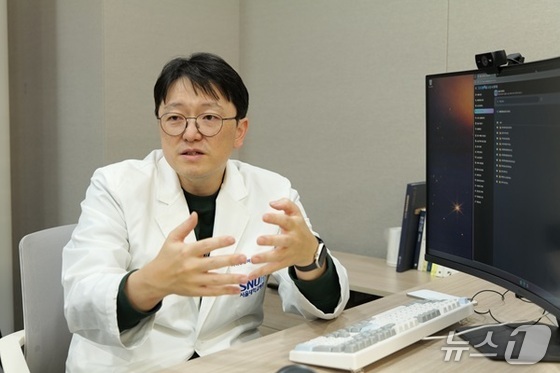
The goal is to create an ecosystem where any healthcare professional can develop their own artificial intelligence (AI) assistant (agent). This goes beyond simply summarizing medical records. AI will support all hospital processes. The vision of Seoul National University Hospital AI (SNUH.AI) is for both professors and nurses to have their own AI assistants.
He began his journey as an electrical engineering student. Entering Seoul National University’s Department of Electrical Engineering in 1999, he delved into the world of data, learning machine learning during the excitement of the 2002 World Cup.
A pivotal moment came during his internship at a U.S. pharmaceutical company. Confronted with vast amounts of medical literature, he felt compelled to grasp the clinical significance behind the data, leading to his bold decision to transfer to Seoul National University’s medical school in 2004.
Even after becoming a physician, he maintained his connection to data and software development. Following the deep learning surge triggered by AlphaGo in 2016 and the advent of ChatGPT in 2022, he began merging his clinical experience as an anesthesiologist with large language model (LLM) technology.
Combining engineering foundations with medical insights, Dr. Lee Hyung-Cheol, Deputy Director of Healthcare AI Research at Seoul National University Hospital, is spearheading fundamental changes in healthcare at the forefront of the AI era. We sat down with him to explore the blueprint for future hospitals and the current state and vision of Agentic AI.
Here’s our interview with the deputy director.
– Seoul National University Hospital launched its proprietary AI platform, SNUH.AI, last November, which is driving the AX (AI transformation) in healthcare. Can you elaborate on this?
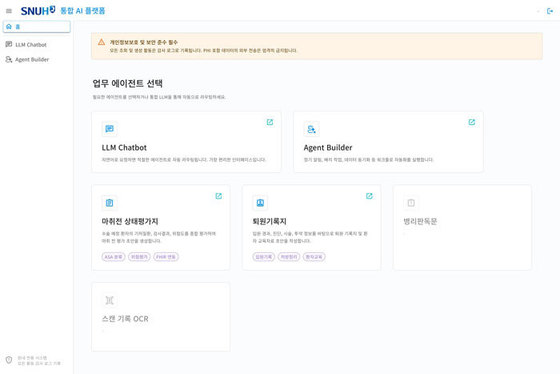
▶ SNUH.AI is a specialized agentic AI platform developed by Seoul National University Hospital to streamline medical tasks. In essence, it’s a hub of intelligent assistants that perform real hospital duties, surpassing basic Q&A AI capabilities.
The platform is available in both cloud and on-premise versions. It strictly separates external (cloud) and internal networks to safeguard patient data. In the cloud environment, users can freely develop AI agents for tasks like literature reviews and guideline searches without accessing patient information. The finished agents are then transferred to the internal network for clinical use.
The aim is to deploy roughly 1,000 customized agents by year-end. The goal is to create a 1 person, 1 AI environment where healthcare professionals and staff can implement AI for their specific tasks.
– Could you provide examples of these 1 person, 1 AI agents?
▶ For physicians, it can create an agent that automatically generates discharge summaries from patient records, tailored to their preferred style and detail level. It also have agents for operating room (OR) nurses and administrative staff. Scheduling dozens of personnel for daily surgical or endoscopic procedures is surprisingly complex. AI can automatically create staffing schedules or analyze OR utilization to suggest efficient timetables.
– I understand other hospitals are also developing AI. What sets your approach apart?
▶ Our focus is on building a platform and ecosystem rather than isolated functions or AI models. While many hospitals are developing AI for specific tasks like automating outpatient records or voice electronic medical record (EMR), Seoul National University Hospital is creating an agent-based platform that allows users to directly implement the tools they need in clinical settings.
– Creating a personalized AI seems challenging. How do you address this?
▶ The key is education, or AI literacy. We’re continuously conducting training sessions across various task forces and departments.
Our agents capture each user’s expertise in natural language. Every professor has their own approach, like determining the appropriate length for a discharge summary. As these insights accumulate on our platform, they become invaluable hospital assets. We’re also actively educating other hospitals through workshops.
– How have other hospitals responded to your initiative?
▶ The response has been overwhelmingly positive. Several hospitals are in the process of finalizing contracts, with some even expressing impatience to get started. Beginning next month, we’ll be conducting monthly workshops at various hospitals. A major advantage of multi-hospital collaboration is the ability to share agents. For instance, tools for medical law searches or terminology mapping can be used across institutions.
– Do you believe your platform can compete in Western markets?
▶ Absolutely. We’ve recently hosted visits from the University of Texas at Austin and Stanford University, demonstrating significant interest in our platform. In the West, hospitals typically rely on enterprise versions from major AI companies like OpenAI or Anthropic, often partnering with tech giants like Google.
However, in South Korea, collaborating with foreign firms can be prohibitively expensive and raises concerns about patient data leaving the country. Developing our own platform is thus safer and more efficient. We’re also planning to expand into Southeast Asian and Middle Eastern markets in the future.
– What’s your ultimate vision for an AI-powered hospital?
▶ This year marks a golden opportunity to transform millennia of medical practice through AI. The traditional roles of hospitals and doctors must fundamentally evolve with AI assistance. We envision integrating patient-AI interactions into clinical practice, enabling doctors to provide optimal judgments and explanations. Moreover, AI should serve as a safety net, verifying decisions and catching potential errors, transforming hospitals into AI-enhanced systems.
Just as the initial trajectory of past technologies shaped their future, this year is crucial for converting hospital operations to AI and implementing them in real clinical settings.