

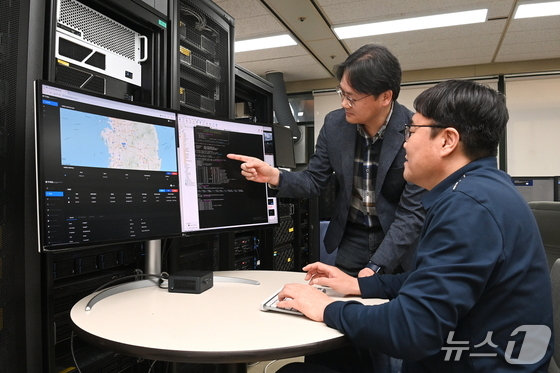
A team of South Korean researchers has pioneered the world’s first international standard for service functionality criteria in the field of Edge Computing, a pivotal technology for next-generation digital industries.
The Electronics and Telecommunications Research Institute (ETRI) announced on Wednesday that the International Telecommunication Union’s Telecommunication Standardization Sector (ITU-T) has approved the international standard ITU-T Y.3541. This standard, which defines the functional requirements for edge computing services, was finalized during the 13th meeting of ITU-T Study Group 13 held in Geneva at the end of February.
Edge computing is an innovative technology that processes data near its point of origin, rather than transmitting it to distant central servers. This approach significantly reduces data processing latency, making it a crucial foundational technology for various applications including autonomous driving, smart factories, real-time video analysis, telemedicine, and artificial intelligence (AI) services.
The newly approved standard represents the first global framework to systematically organize the functional requirements for creating edge computing services. It effectively provides a standard blueprint enabling diverse companies and organizations to develop interoperable edge computing services under a unified set of guidelines.
A prime example of its application is in autonomous driving. Processing vast amounts of sensor data within a vehicle can lead to excessive power consumption and costs. However, this new standard allows nearby edge servers to handle complex computations and instantly relay results to the vehicle. This structure enables autonomous vehicles to efficiently utilize high-performance AI services with minimal latency.
Dr. Kim Dae-won from ETRI and Professor Oh Myung-hoon from Honam University’s Department of Computer Engineering were instrumental in developing this standard. Since 2022, they have spearheaded the international standard development as representatives of the Korean ITU research committee under the Ministry of Science and Information and Communications Technology (ICT).
Dr. Kim remarked that this achievement bridges research and development outcomes with international standards, simultaneously securing technological competitiveness and leadership in standardization. He expressed optimism about its positive impact on domestic companies’ global market entry.
Professor Oh emphasized that the continuous success in standardization efforts, from concept definition to actual service functionalities and AI-based expansions, demonstrates that Korean researchers are at the forefront of shaping the global edge computing technology framework.
This breakthrough is part of a national research and development project funded by the Ministry of Science and ICT and the Institute for Information & Communications Technology Planning & Evaluation (IITP). The project, titled, Development of Flexible Medical 5G Edge Computing Software to Support Mobile Customized Medical Services, is led by Dr. Sun-wook Kim from ETRI.
The research focuses on developing technology for flexible integration and operation of medical devices and AI software in mobile hospital environments. Insights gained from this process have been incorporated into the international standard.
Moving forward, the research team plans to establish domestic standards based on this framework and develop technical guidelines for practical industry application. They also aim to continue their international standardization efforts in the realm of AI services powered by edge computing.