

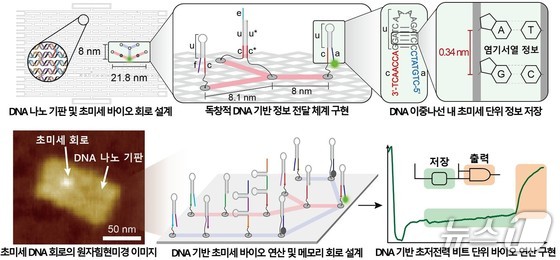
The Korea Advanced Institute of Science and Technology (KAIST) announced on Wednesday that a research team led by Professor Choi Young-jae from the Graduate School of Biological Sciences has developed a groundbreaking DNA-based bio-transistor. This innovative technology enables simultaneous computation and information storage, paving the way for a new generation of molecular circuits.
As semiconductor processes approach the 2-nanometer (nm) threshold, the physical limits of miniaturization are becoming increasingly apparent. In response, researchers are actively exploring novel computing methods that process information at the molecular level, moving beyond traditional silicon-based technologies.
DNA’s unique property of complementary base pairing allows for precise control over desired reactions. With an incredibly small base spacing of just 0.34 nanometers, DNA has emerged as a promising candidate for next-generation, ultra-high-density information processing. However, previous DNA-based circuits were limited by their single-use nature, hampering continuous information processing and complex calculations.
To overcome these limitations, the research team engineered a system where DNA molecules can dynamically bond or separate based on input signals, allowing for real-time reconfiguration and information retention. This breakthrough resulted in a reset-free circuit capable of processing information continuously without the need for separate initialization.
The team emphasized the significance of this research, noting that it replicates transistor functionality—a cornerstone of semiconductor technology—at the DNA level. This advancement lays the foundation for intelligent bio-systems where molecules can autonomously process and store information, transcending simple chemical reactions.
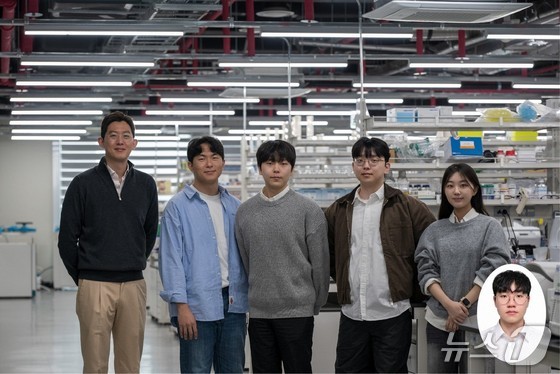
This research represents a significant leap forward in the potential for DNA-based molecular computing, Professor Choi stated. It could revolutionize the fields of bio-computing and medical technology, opening up entirely new avenues for innovation.
The study was a collaborative effort involving KAIST researchers Professor Lim Seong-soon, Kim Tae-hoon, Jeong Sang-eun, and Kim Si-on, alongside Gwangju Institute of Science and Technology (GIST) students Kim Woo-jin and Shim Jun-ho. Professor Choi served as the corresponding author.
The groundbreaking findings have been published in the prestigious international journal Science Advances.
This research was made possible through support from the Ministry of Science and ICT’s Future Promising Convergence Technology Pioneer Project, the Ministry of Education’s Basic Research Project, and the KAIST Quantum(+X) Convergence Research and Development Project.